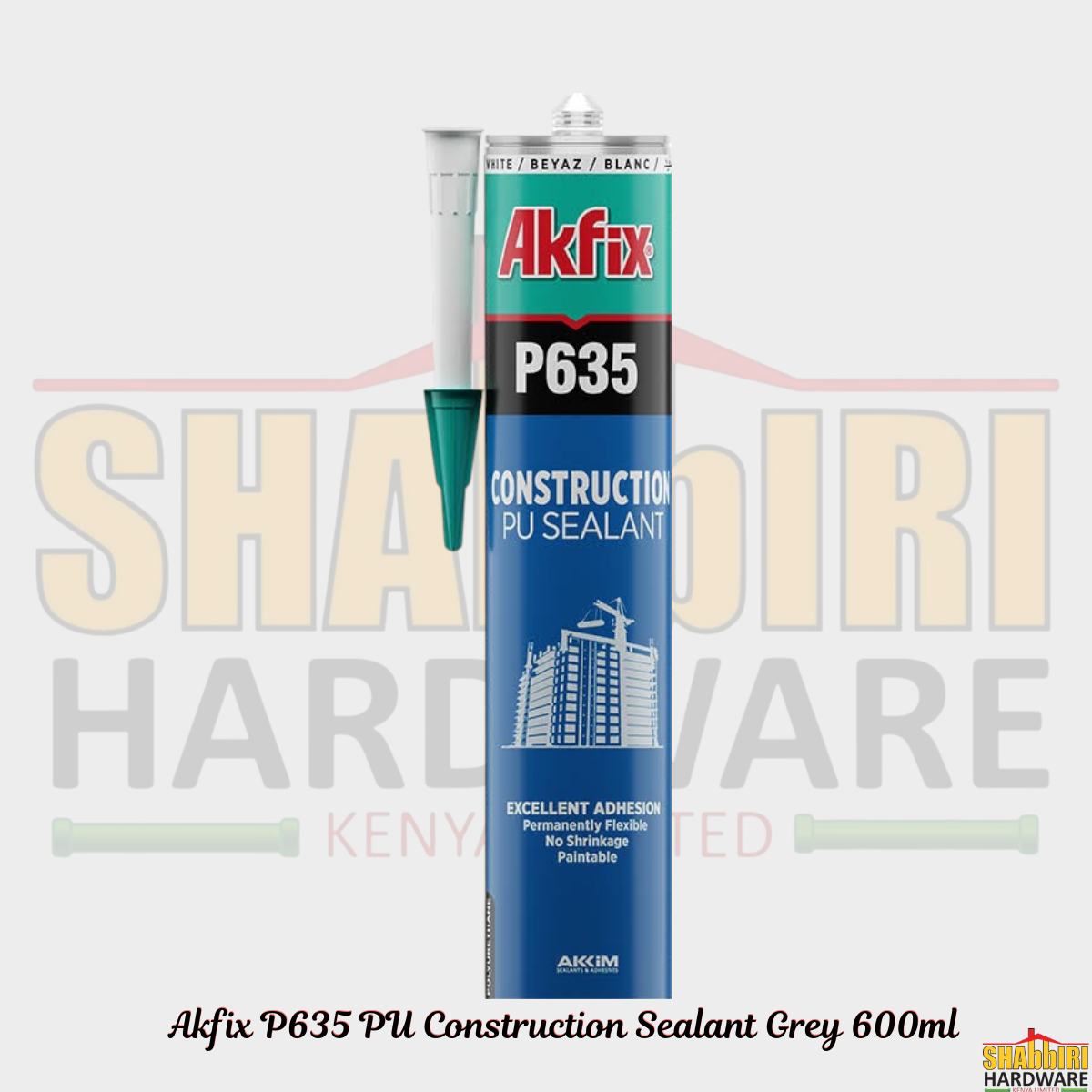
Akfix P635 PU Construction Sealant Grey 600ml – Polyurethane Joint Sealant for Concrete & Expansion Joints
Akfix P635 PU Construction Sealant Grey 600ml
A professional-grade, one-component polyurethane construction sealant that cures on contact with atmospheric moisture to form a tough, permanently elastic rubber seal. It is engineered for the movement joints, perimeter joints and construction gaps that every building develops — the places where a rigid filler such as cement mortar or acrylic putty will crack open within a season.
The grey shade is the contractor's default for concrete, screed, precast panels, kerbs, blockwork and galvanised steel, because it disappears into the substrate instead of drawing the eye the way a white bead does.
The 600ml foil sausage is the professional's format: it loads into a standard sausage gun, delivers almost twice the output of a 310ml cartridge, produces roughly 90% less packaging waste, and works out considerably cheaper per metre on any job with real joint runs to seal.
Available now at Shabbiri Hardware, Magadi Road, Ongata Rongai, and at our Tuala branch past Nazarene University.
Technical Specifications
→ Swipe the table sideways to see all values
| Property | Specification |
|---|---|
| Product name | Akfix P635 Construction PU Sealant |
| Product code | P635 |
| Brand | Akfix (Akkim Construction Chemicals, Türkiye) |
| Category | Construction sealants & adhesives / Polyurethane sealants |
| Colour | Grey (also available in white, black and brown) |
| Pack size | 600 ml foil sausage (310 ml cartridge also available) |
| Packing | 20 sausages per carton (typical) |
| Country of origin | Türkiye |
| Chemical base | Single-component polyurethane, moisture-curing |
| Consistency | Thixotropic, non-sag paste |
| Density | ~1.20 – 1.30 g/ml |
| Solids content | 100% (solvent-free) |
| Skin-over / tack-free time | 60 – 90 minutes (23 °C / 50% RH) |
| Curing rate | ~3 mm per 24 hours |
| Full cure (12 mm joint) | 5 – 7 days |
| Shore A hardness | 40 ± 5 |
| Tensile strength | ≥ 1.4 N/mm² |
| Elongation at break | ≥ 500% |
| Elastic recovery | ≥ 80% |
| Movement accommodation | ± 25% of joint width |
| Sag / flow | ≤ 2 mm (non-sag) |
| Volume shrinkage | < 3% (effectively nil) |
| Application temperature | +5 °C to +40 °C |
| Service temperature | −40 °C to +90 °C |
| Paintable | Yes, after skin formation (test-patch first) |
| Standards | ISO 11600 F 25 HM; ASTM C-920 Type S, Grade NS, Class 25 |
| Shelf life | 12 months unopened |
| Storage | +5 °C to +25 °C, dry, out of direct sunlight |
Key Features & Benefits
Excellent adhesion — usually no primer
Grips concrete, screed, plaster, brick, blockwork, natural and cast stone, ceramic, glass, aluminium, galvanised and painted steel, timber, and most rigid plastics.
Permanently flexible
Accommodates ±25% of the original joint width in movement, so seasonal and structural movement is absorbed instead of splitting the seal.
No shrinkage
100% solids chemistry means the bead you tool is the bead you keep. No solvent to evaporate, no hollowing or sinking as it cures.
Fully paintable
Accepts most water-based and alkyd paint systems once skinned over, so beads can be finished flush with the wall colour. Always test-patch first.
Weather, UV & ageing resistant
Holds up to direct tropical sun, driving rain and repeated wet/dry cycling without becoming brittle or chalky.
Non-sag / thixotropic
Stays put in vertical and overhead joints without slumping.
High mechanical strength
Resists abrasion, tearing and light foot traffic once fully cured — suitable for floor joints as well as wall joints.
Solvent-free formulation
Isocyanate-cured, low odour, and no shrink-back from solvent loss. Sandable and over-coatable after full cure.
International standards
Formulated to the elastic-sealant class ISO 11600 F 25 HM and to ASTM C-920 performance criteria.
Where to Use Akfix P635 Grey PU Sealant
🏗 Concrete & Civil Works
- Expansion, control and construction joints in slabs, screeds and pavements
- Precast concrete panel joints and connection joints
- Kerb, culvert, manhole and drainage channel joints
- Concrete cracks routed out to a sound V or square profile
- Warehouse, workshop and parking-deck floor joints
🏘 Buildings & Finishes
- Perimeter joints around window and door frames in masonry openings
- Joints between dissimilar materials — concrete to metal, blockwork to timber, plaster to aluminium
- Façade, cladding and curtain-wall movement joints
- Parapet, coping, flashing and roof-detail sealing on non-bituminous details
- Skirting, threshold and stair-nosing perimeter sealing
⚙ Metal, Timber & Industrial
- Gutter, downpipe, box-profile and IBR roof-sheet lap sealing
- Steel structure joints, ducting seams and prefabricated panel joints
- Container, truck body, trailer, bus and caravan body sealing
- Marine and boat-building applications above the waterline
- Timber joinery, staircases and general carpentry gap-filling
How to Use PU Construction Sealant (Step by Step)
Surface Preparation
- The joint must be clean, dry, sound and structurally stable. Remove all dust, laitance, loose particles, old sealant, curing compounds, form-release oil, grease, rust and flaking paint.
- Mechanically clean concrete and masonry — wire brush, grinder, or route the joint out to a fresh square profile.
- Degrease non-porous surfaces (metal, glass, glazed tile, plastics) with isopropyl alcohol or Akfix cleaner and let it flash off completely.
- New concrete must be at least 28 days old and fully cured before sealing.
- Protect joint edges with masking tape for a razor-sharp line on visible work.
Priming (only where needed)
- No primer is required on most common substrates.
- Use a PU primer on highly porous or friable concrete, joints under permanent water contact, joints under continuous heavy traffic, and marginal substrates.
- If in doubt, run an adhesion test: apply a 100 mm bead, allow 7 days to cure, then peel it. Cohesive failure (the sealant tears within itself) = good bond. Adhesive failure (it peels clean off) = prime, or the surface is unsuitable.
Insert Backer Rod
- Press a closed-cell polyethylene backer rod into the joint to the correct depth. Choose a rod roughly 25% wider than the joint so it holds itself in place by compression.
- Do not puncture the rod — a punctured closed-cell rod releases gas and creates bubbles in the bead.
- Where the joint is too shallow for a rod, lay bond-breaker tape along the joint base instead.
Load and Apply
- Cut the 600ml foil sausage open at one end, drop it into a sausage gun (a 600ml skeleton or barrel gun — a standard 310ml cartridge gun will not take it), fit the nozzle and screw the cap on.
- Cut the nozzle at a 45° angle to a width slightly smaller than the joint.
- Hold the gun at 45° to the joint and apply with steady, continuous pressure, pushing the bead ahead of the nozzle rather than dragging it behind. Pushing forces sealant into the joint and eliminates voids.
- Fill the joint completely, in one continuous pass. Stopping and restarting introduces air pockets and cold joints.
Tool the Bead
- Tool within 10–15 minutes, well before skin formation.
- Use a spatula, joint tool or soap-and-water-wetted finger to press the sealant firmly against both joint faces and form a slightly concave profile.
- Do not use silicone smoothing agents or detergent-heavy solutions on PU — plain soapy water lightly applied is enough.
- Remove masking tape immediately after tooling, while the sealant is still wet, pulling it away from the bead at an angle.
Cleaning
- Clean uncured sealant and tools immediately with white spirit, acetone or Akfix PU cleaner.
- Wipe skin contact off with a dry cloth first, then soap and water. Do not use solvent directly on skin.
- Cured sealant can only be removed mechanically — by cutting or abrading. There is no practical solvent once it has cured, so work clean.
Curing, Painting & Overcoating
- Cures at roughly 3 mm per 24 hours; a 12 mm-deep joint needs about 5–7 days for a full through-cure.
- Curing is faster in warm, humid conditions and slower in cool, dry ones. Do not force-cure with heat.
- Do not disturb, wash down or expose the bead to standing water for the first 24 hours.
- Painting: wait until the surface has skinned fully (ideally 24 hours or more), then apply water-based or alkyd paint. Because the bead stays elastic, hard brittle paint films may hairline-crack over a moving joint — that is a property of the paint, not a sealant failure. Always test-patch your paint system first.
Coverage Chart — One 600ml Sausage
→ Swipe the table sideways to see all values
| Joint size (width × depth) | Metres per 600 ml sausage | ||||||||||
|---|---|---|---|---|---|---|---|---|---|---|---|
| 5 × 5 mm | ~24.0 m | ||||||||||
| 6 × 6 mm | ~16.7 m | ||||||||||
| 8 × 8 mm | ~9.4 m | ||||||||||
| 10 × 6 mm | ~10.0 m | ||||||||||
| 10 × 10 mm | ~6 KSH 1,740/ piece In stock Delivery on request — same-day within Nairobi, next-day countrywide. Free pickupat Rongai & Tuala branches. Qty 📲 Order on WhatsApp1 100% genuine, sourced materials Secure M-Pesa & card payment Countrywide delivery arranged 100% Genuine No fakes, ever Quality assured Trusted brands only Countrywide delivery Arranged on request Expert advice Sales team on WhatsApp Specifications
Customer reviewsNo reviews yet — be the first to review this product. Frequently bought togetherCustomers who bought this often add these to their order.     |