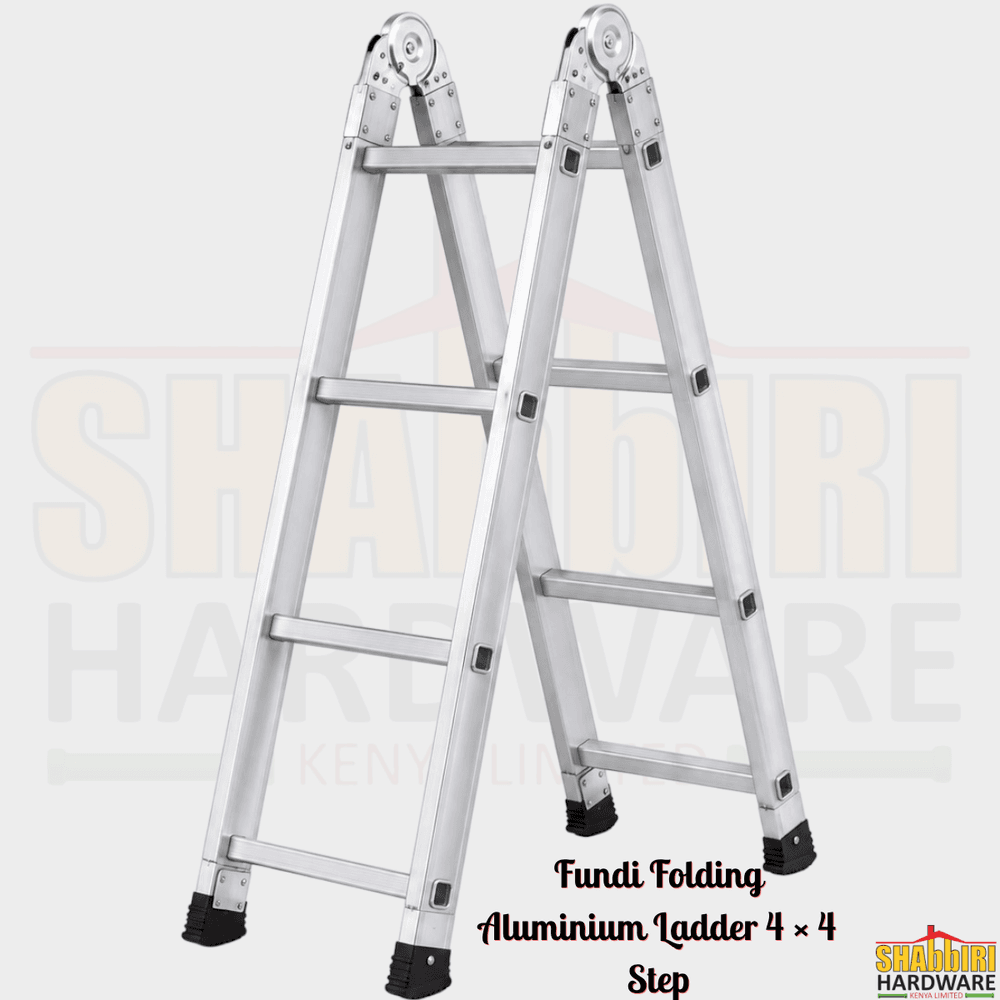
Fundi FFL44 Folding Aluminium Ladder 4 x 4 Step (16 Step Multi-Purpose Ladder, 4.7m, 150kg)
Fundi Folding Aluminium Ladder FFL44 – 4 x 4 Step Multipurpose Ladder (16 Rungs)
The Fundi FFL44 folding aluminium ladder is a four-section multipurpose ladder with four rungs per section — 16 rungs in total. Four self-locking hinges let it become a straight extension ladder of about 4.6 metres, an A-frame step ladder, a stairway ladder, or a low scaffold base — then fold down to roughly 1.2 m to fit in a car boot. Light aluminium construction, serrated non-slip rungs and a 150 kg working load make it the go-to access ladder for painters, electricians, signage crews, plumbers, gutter cleaners and homeowners across Nairobi, Ongata Rongai, Kiserian, Karen, Ngong and Kajiado.
Product Overview – Fundi FFL44 Multipurpose Folding Ladder
One ladder that replaces a step ladder, an extension ladder and a stair ladder.
The Fundi FFL44 4 x 4 step folding aluminium ladder belongs to the Fundi folding ladder range stocked at Shabbiri Hardware alongside the smaller FFL43 (4 x 3 step, 12 rungs) and the taller FFL45 (4 x 5 step, 20 rungs). The "4 x 4" designation means four hinged sections, each carrying four rungs — the mid-size option, and the best all-round choice for single-storey Kenyan homes, shops, godowns and site work where a 4.6 m straight reach covers ceiling boards, gutters, security lights, CCTV cameras, signage and roof edges.
Each section is built from extruded aluminium alloy tube with wide, serrated flat rungs riveted into the stiles. Four heavy-duty multi-position hinges lock automatically at set angles, so the ladder holds its shape without straps, pins or extra tools. Because aluminium does not rust, the FFL44 handles the coastal humidity, long rains and dusty upcountry conditions that quickly corrode steel ladders — while staying light enough for one person to carry up a staircase.
🔒 Auto-Locking Hinges
Four multi-position hinges click and lock at 0°, 90° and 180°. Release buttons on both sides prevent accidental collapse under load.
🪜 Serrated Non-Slip Rungs
Wide flat rungs with a serrated tread give secure footing in boots, even with wet, dusty or paint-splashed soles.
🚗 Fits in a Car Boot
Folds to roughly 1.2 m — carries in a saloon boot, pick-up bed, matatu or on a boda for site-to-site jobs.
🛡️ Rust-Free Aluminium
Aluminium alloy will not rust like a steel ladder and needs no painting — ideal for outdoor and coastal use.
⚡ Light but Strong
About 11.5 kg with a 150 kg working load, so one technician can carry the ladder plus tools comfortably.
🦶 Anti-Slip End Caps
Moulded rubber/PVC feet grip cabro, screed, tiles and timber floors, and protect indoor finishes from scuffing.
Full Technical Specifications – Fundi FFL44
Complete dimensional, structural and performance data for the 4 x 4 step folding aluminium ladder.
| Product name | Fundi Folding Aluminium Ladder FFL44 – 4 x 4 Step Multipurpose Ladder |
|---|---|
| Model / SKU | FFL44 |
| Brand | Fundi |
| Ladder type | Multipurpose 4-section folding (articulated) ladder |
| Sections | 4 hinged sections |
| Steps per section | 4 rungs |
| Total rungs | 16 |
| Rung spacing (pitch) | ≈ 290 – 300 mm |
| Folded (transport) length | ≈ 1.15 – 1.25 m |
| Extended straight ladder length | ≈ 4.55 – 4.70 m |
| A-frame (step ladder) height | ≈ 2.20 – 2.35 m |
| Typical working / reach height | ≈ 5.4 m (straight, with average user reach) |
| Folded pack thickness | ≈ 200 – 230 mm (4 sections nested) |
| Outside stile width | ≈ 430 – 460 mm |
| Net weight | ≈ 11 – 12 kg |
| Stile (side rail) material | Extruded aluminium alloy (6000-series type), mill / anodised finish |
|---|---|
| Stile wall thickness | ≈ 1.0 – 1.4 mm (heavy-duty section) |
| Rung profile | Wide flat rung with serrated anti-slip tread, riveted/crimped to stiles |
| Hinge type | 4 x multi-position locking hinges, double-sided release buttons |
| Hinge lock angles | 0° (folded), 90° (A-frame / stair), 180° (straight) |
| Hinge material | Die-cast aluminium / steel pin assembly |
| Feet | Moulded anti-slip rubber or PVC end caps on all 4 stiles |
| Maximum working load | 150 kg (user + tools + materials) |
| Duty classification | Trade / heavy-domestic duty, EN 131 style rating |
| Recommended safe working angle | 75° (1 out for every 4 up) in straight mode |
| Corrosion resistance | Rust-free aluminium; no painting or galvanising required |
| Electrical note | Aluminium conducts electricity — not for live electrical work; use a fibreglass ladder for that |
| Country of origin | Imported (Fundi brand) |
| Packaging | Single folded unit, shrink-wrapped / carton |
| Warranty | Manufacturer defect cover as per Shabbiri Hardware terms |
| Model | Configuration | Total Rungs | Straight Length | Best For |
|---|---|---|---|---|
| Fundi FFL43 | 4 x 3 step | 12 | ≈ 3.5 m | Ceilings, indoor lights, shop shelving |
| Fundi FFL44 | 4 x 4 step | 16 | ≈ 4.6 m | Single-storey roofs, gutters, signage, CCTV |
| Fundi FFL45 | 4 x 5 step | 20 | ≈ 5.8 m | Double-storey, tall walls, mast/antenna work |
Dimensions are nominal and may vary slightly by production batch. Confirm exact measurements at either Shabbiri Hardware branch before purchase.
Four Working Positions – One Ladder, Four Jobs
How to set the FFL44 up for each configuration.
Straight Extension Ladder
Unfold all four sections into one line until every hinge clicks at 180°. Gives ≈ 4.6 m of ladder — lean against a wall at 75° for gutters, roof edges, security lights and painting high walls.
A-Frame Step Ladder
Lock the two centre hinges at 90° so the ladder forms a self-supporting A. Roughly 2.25 m tall — free-standing for ceiling boards, fans, bulbs, curtain rails and painting.
Stairway / Uneven Ground
Set the hinges so one pair of legs is short and one long, letting the ladder stand square on a staircase, kerb or sloping compound.
Scaffold Base
Fold flat into a low trestle, or pair two FFL44 ladders in A-frame with a rated scaffold plank across matching rungs for a low working platform.
How to Use the Fundi FFL44 Folding Aluminium Ladder
Step-by-step setup, safe working practice and folding down.
Inspect before every use
Check all four hinges, rivets and rubber feet. Look for bent stiles, cracked rungs, loose rivets or missing end caps. Never climb a ladder with a damaged or seized hinge.
Choose your working position
Decide whether the job needs the straight ladder (≈ 4.6 m), the A-frame (≈ 2.25 m), the stairway setting or the trestle. Set the ladder up on the ground first, never while standing on it.
Release and rotate the hinges
Press the release buttons on both sides of a hinge at the same time, rotate the section to the angle you want, then let the buttons spring back. Listen for the audible click on both sides.
Confirm every hinge is locked
Push and pull each joint firmly by hand. A hinge that still moves is not locked — cycle it again until it holds solid. All four hinges must be locked before anyone climbs.
Position on firm, level ground
Place all four feet on solid, level, non-slippery ground. Avoid loose murram, wet tiles and soft soil. On smooth screed or terrazzo, put a rubber mat or a helper's foot at the base.
Set the 75° angle in straight mode
Use the 1-in-4 rule: for every 4 units of height, the base sits 1 unit out from the wall. At 4.6 m, that is about 1.15 m from the wall. Extend at least 1 m above a roof edge you plan to step onto.
Climb correctly
Face the ladder, keep three points of contact (two hands and a foot, or two feet and a hand), and carry tools in a belt or hoist them up with a rope — not in your hands.
Keep your body inside the stiles
Don't over-reach sideways — your belt buckle should stay between the two side rails. Climb down and move the ladder instead. Never stand on the top two rungs in A-frame mode.
Fold down and store
Bring the ladder to the ground, release each hinge and fold section onto section until it packs to ≈ 1.2 m. Wipe off paint, cement or mud, and store dry, flat or hung horizontally on wall brackets, away from direct sun and chemicals.
⚠️ Safety Guidelines – Read Before Climbing
- Never exceed 150 kg total — that is the user plus tools, paint, tiles or any load being carried.
- One person on the ladder at a time, unless the manufacturer's plate states otherwise.
- Do not use near live electrical conductors. Aluminium conducts electricity — for switchboards, overhead lines or live panels use an insulated fibreglass ladder.
- Do not use in strong wind or heavy rain, and never on wet roofing sheets.
- Never modify the ladder — no welding, drilling, cutting, joining to another ladder, or lengthening with timber.
- Keep fingers clear of the hinges when folding; the locking mechanism closes fast.
- Do not use as a walkway or bridge between two supports unless a rated scaffold plank is fitted across a proper trestle setup.
- Retire a damaged ladder. A bent stile, cracked weld or failed hinge means the ladder is scrap — do not attempt a site repair.
✔ Do
- Wear closed, clean, non-slip footwear
- Face the ladder going both up and down
- Have a helper foot the base on smooth floors
- Clean paint and cement off rungs after each job
- Store folded, dry and out of direct sunlight
✘ Don't
- Stand on the top two rungs of the A-frame
- Over-reach beyond the side rails
- Place on boxes, drums, blocks or scaffolding to gain height
- Climb with tools or materials in your hands
- Leave the ladder set up unattended near children
Who Uses the FFL44 – Trades & Applications
Typical jobs the 4 x 4 step folding ladder is bought for in Kenya.
🎨 Painters & Decorators
High walls, staircases, ceiling cornices and exterior gable ends — A-frame indoors, straight ladder outside.
🔌 Electricians & Solar Fitters
Conduit runs, security floodlights, CCTV cameras and solar panel brackets (power isolated).
🏠 Roofers & Gutter Cleaners
Reaching single-storey roof edges, clearing gutters before the long rains, fixing fascia boards.
🏪 Shops & Godowns
Restocking high shelves, changing signage and banners, servicing lights in retail and warehouse space.
🛠️ Plumbers & Tank Fitters
Water tank stands, overhead pipe runs, gutter-to-tank downpipes and ceiling-void access.
🏡 Homeowners
Curtain rails, ceiling fans, bulbs, tree trimming, wall units and general DIY around the compound.
Frequently Asked Questions – Fundi FFL44 Ladder
What customers ask before buying a folding aluminium ladder in Kenya.
What does "4 x 4 step" mean on the FFL44?
It means the ladder has four hinged sections and each section carries four rungs — 16 rungs in total. The FFL43 is 4 x 3 (12 rungs) and the FFL45 is 4 x 5 (20 rungs).
How high does the Fundi FFL44 ladder reach?
Fully extended as a straight ladder it measures about 4.6 m, giving a practical working reach of roughly 5.4 m for an average user. As an A-frame step ladder it stands about 2.25 m tall.
How much weight can it carry?
The FFL44 is rated for a 150 kg maximum working load, which includes the user plus all tools and materials being carried.
Will it fit in a car?
Yes. Folded it is about 1.2 m long and roughly 200–230 mm thick, so it fits in most saloon boots with a seat folded, and easily in a pick-up, van or on a roof rack.
Can I use it for electrical work?
Only with the power isolated. Aluminium conducts electricity, so for live panels, switchboards or work near overhead lines you should use an insulated fibreglass ladder instead.
What is the price of the Fundi FFL44 in Kenya?
Prices move with import and exchange rates, so we quote live. Call or WhatsApp 0741 042484 / 0745 554008, or email shabbirihardware@gmail.com for today's price and any trade or bulk discount.
Do you deliver outside Ongata Rongai?
Yes. We deliver around Rongai, Tuala, Kiserian, Ngong, Karen, Langata and greater Nairobi, and we can send countrywide through courier or matatu parcel services.
Should I choose the FFL43, FFL44 or FFL45?
Pick the FFL43 for indoor ceiling work, the FFL44 for single-storey roofs, gutters and signage, and the FFL45 when you regularly work at double-storey height. The FFL44 is the most popular all-round size.
Does the ladder rust?
No. It is aluminium alloy, so it will not rust like a steel or angle-iron ladder. Just wipe off cement, paint or chemicals and store it dry.
Do you accept M-Pesa?
Yes — we accept M-Pesa, cash and bank transfer at both the Magadi Road Ongata Rongai and Tuala branches.
Where to Buy the FFL44 – Visit Shabbiri Hardware
Two branches on Magadi Road. Come and open the ladder in the shop before you buy.
🏬 Rongai Branch (Main)
Magadi Road, Ongata Rongai, Kajiado County
Address: Shabbiri Hardware, Magadi Road, Ongata Rongai
Phone: 0741 042484 | 0745 554008
Email: shabbirihardware@gmail.com
Website: www.shabbirihardware.co.ke
🏬 Tuala Branch
Tuala, past Africa Nazarene University
Address: Shabbiri Hardware, Tuala, Magadi Road — past Africa Nazarene University
Phone: 0745 554008 | 0741 042484
Email: shabbirihardware@gmail.com
Website: www.shabbirihardware.co.ke
Get Today's Price on the Fundi FFL44 Ladder
Talk to our team for live pricing, trade rates, bulk orders and delivery around Rongai, Tuala, Kiserian, Ngong, Karen and greater Nairobi.
Related Ladders & Access Equipment
Other sizes and access tools stocked at Shabbiri Hardware.
Specifications
| Brand | Fundi |
| Model | FFL44 |
| Category | Power Tools |
| Availability | In stock |
| Sourced by | Shabbiri Hardware Kenya Limited |
Customer reviews
No reviews yet — be the first to review this product.
Frequently bought together
Customers who bought this often add these to their order.