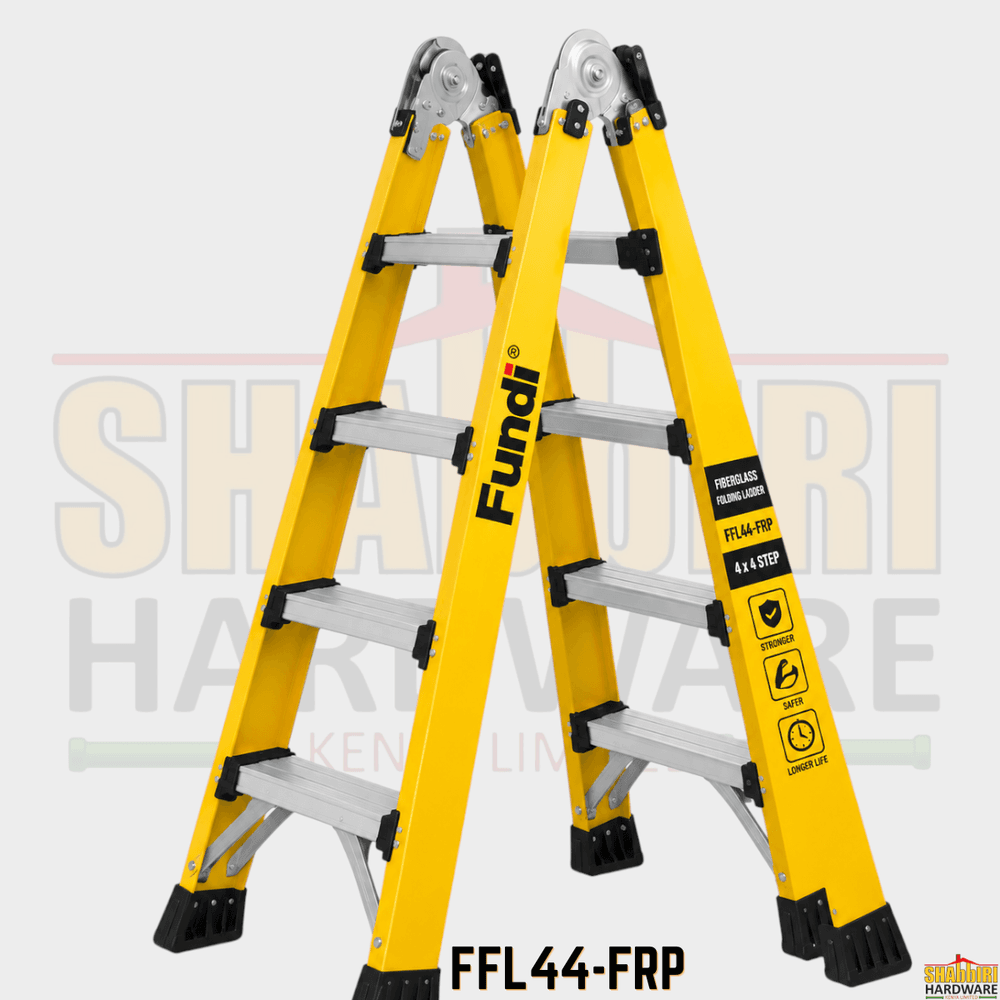
Product Overview — What the FFL44-FRP Is Built For
Fiberglass folding ladder for electrical, solar, telecom, signage and general maintenance work in Kenya.
The Fundi FFL44-FRP is the fiberglass-reinforced-polymer version of the popular Fundi FFL44 multipurpose folding ladder. It is built from four hinged sections, each carrying four rungs, giving 16 rungs in total. Four multi-position locking hinges let one person reconfigure the ladder in seconds without tools, so a single unit replaces a step ladder, an extension ladder, a stairway ladder and a pair of trestles.
4 working positions
Straight extension, A-frame step ladder, stairway/staircase ladder, and low scaffold trestle with a plank.
Electrically safe
Non-conductive FRP rails for live-adjacent work — switchboards, meter boxes, solar and telecom.
One-person handling
Folds to roughly 1.01 m and about 15.5 kg — carries in a pickup, a station wagon or a boda trailer.
Weatherproof
Rust-proof, UV-stabilised and moisture-resistant. Suited to outdoor site storage and coastal projects.
Anti-slip everywhere
Serrated wide rungs, textured rail surfaces and non-marking rubber feet that will not scratch tiles.
EN131 duty
Rated to 150 kg total load — user plus tools plus materials — for professional daily site use.
Full Technical Specifications — Fundi FFL44-FRP
Complete dimensional, structural, material and safety data for the 4 x 4 step fiberglass folding ladder.
| Identification | |
| Model code | FFL44-FRP |
|---|---|
| Brand | Fundi |
| Product type | Multi-position folding fiberglass (FRP) ladder |
| Configuration | 4 sections × 4 steps per section = 16 rungs |
| Category | Ladders & Access Equipment › Folding Ladders |
| Dimensions | |
| Maximum straight (extension) length | Approx. 4.70 m (470 cm) |
| A-frame (step ladder) height | Approx. 1.80 m |
| Top standing / platform level in A-frame | Approx. 1.01–1.50 m depending on rung used |
| Folded (transport) length | Approx. 1.01 m |
| Folded pack size | Approx. 101 × 38 × 28 cm |
| Overall ladder width | Approx. 38 cm |
| Rung-to-rung spacing (pitch) | Approx. 29 cm |
| Rung tread depth | Approx. 30–32 mm serrated flat rung |
| Safe working height (straight position) | Approx. 5.5–5.7 m to hand reach |
| Materials & Construction | |
| Side rails | Fiberglass Reinforced Polymer (FRP), pultruded box profile, UV-stabilised resin |
| Rungs / steps | Aluminium alloy, serrated anti-slip tread, mechanically swaged and riveted to the rails |
| Hinges | 4 × heavy-duty multi-position locking hinges, zinc-plated steel, spring-loaded release buttons |
| Hinge lock positions | Typically 0°, 90°, 180° detents per hinge (straight, A-frame, stair and scaffold set-ups) |
| Fasteners | Corrosion-resistant rivets and bolts |
| Feet | Non-marking, non-slip moulded rubber end caps on all four rail ends |
| Finish | Moulded-in colour (does not require paint); smooth gel-coated rail surface |
| Net weight | Approx. 15.5 kg (FRP version; the aluminium FFL44 is approx. 12.7 kg) |
| Performance & Safety Ratings | |
| Maximum load rating | 150 kg total (user + clothing + tools + materials) |
| Duty classification | EN131 Professional / trade duty |
| Electrical property | Non-conductive FRP rails — dielectric barrier for work near live circuits (rails typically tested to 30 kV class) |
| Flammability | Self-extinguishing / flame-retardant resin system |
| Corrosion resistance | Rust-proof, moisture-proof, resistant to cement, lime, most site chemicals and salt air |
| Operating temperature | Suitable for −10°C to +60°C — covers all Kenyan site conditions |
| Slip resistance | Serrated rung tread + non-slip rubber feet |
| Working Configurations | |
| 1. Straight / extension ladder | All hinges locked at 180° — full 4.70 m for wall, roof, gutter, mast and pole access |
| 2. A-frame step ladder | Centre hinge at 90° — free-standing 1.80 m for ceilings, gypsum, lights and signage |
| 3. Stairway / staircase ladder | Uneven leg set-up for working safely on staircases and split levels |
| 4. Scaffold / trestle | Two units plus a certified plank form a low working platform for painting and plastering |
| Supply & Support | |
| Supplied as | Fully assembled, folded, ready to use out of the box |
| Availability | In stock at Ongata Rongai and Tuala branches |
| Delivery | Nairobi metro delivery and countrywide courier / parcel dispatch arranged on request |
| Payment | Cash, bank transfer, or M-Pesa Paybill 542 542, Account No. 78653 |
| Related models | FFL43 (4 × 3 step, 12 rungs) · FFL45 (4 × 5 step, 20 rungs) |
How to Use the Fundi FFL44-FRP Folding Fiberglass Ladder
Step-by-step set-up for each of the four working positions, plus the pre-use checks that keep your team safe.
A. Pre-use inspection — every single time (2 minutes)
- Check all four FRP rails for cracks, deep gouges, splintering or exposed white fibres. Any of these means the ladder is retired, not repaired.
- Press each hinge release button — it must click positively into its detent and hold with no side play.
- Confirm every rung is tight in the rail with no rotation, and no rivets are missing or proud.
- Check that all four rubber feet are present, clean and not worn smooth.
- Wipe oil, grease, mud or cement slurry off rungs and feet before climbing.
- Confirm the total weight going up — you plus tools plus materials — stays under 150 kg.
B. Setting up as a straight extension ladder (4.7 m)
Lay it flat and clear the area
Place the folded ladder on level ground with the hinge buttons facing up. Keep bystanders clear of the swing path.
Unfold section by section
Press the release button on the first hinge, swing the next section out to fully straight, and let the button spring back into the 180° detent. Repeat for hinges 2, 3 and 4.
Confirm every lock
Walk the length of the ladder and physically check that all four hinges are seated. A hinge left mid-travel is the single most common cause of folding-ladder accidents.
Raise and set the angle
Walk the ladder up hand over hand and lean it against a solid surface at the 4:1 rule — 1 metre out from the wall for every 4 metres of height. At 4.7 m that is roughly 1.2 m of base offset.
Secure top and bottom
Extend at least 1 m above a roof edge if you will step off, tie the stiles off at the top where possible, and have a second person foot the base on smooth floors.
Climb correctly
Face the ladder, keep three points of contact, keep your belt buckle inside the rails, and hoist tools by rope or a tool belt rather than carrying them in your hands.
C. Setting up as an A-frame step ladder (1.8 m)
Open to straight first
Unfold all four sections to the straight position as described above.
Break the centre hinge
Release the middle hinge only and fold the ladder into an inverted V until the hinge locks at 90°.
Level all four feet
Set it on firm, level ground. Never pack a short leg with bricks, blocks or timber offcuts — move the ladder instead.
Respect the top-rung rule
Do not stand on the top two rungs of the A-frame, and never straddle the apex. If you cannot reach, you need the FFL45 or a taller access solution.
D. Stairway configuration
Set uneven legs
Lock the two front sections short and the two rear sections long so the front feet sit on the upper tread and the rear feet on a lower tread.
Check for level rungs
The working rungs must sit horizontal. Adjust the hinge positions until they do, then re-verify every lock before climbing.
Block the stairwell
Close the staircase to traffic while you work — a person brushing past at stair level is enough to unbalance the ladder.
E. Scaffold / trestle configuration
Form two low trestles
Fold each of two FFL44-FRP ladders into the low trestle setting so the supporting rungs sit at the same height.
Bridge with a rated plank
Use a certified scaffold plank or staging board rated for the span and load — never an ordinary timber offcut.
Limit the span and the load
Keep the plank span short, one worker on the board at a time, and keep the working height low. This set-up is for painting, plastering and ceiling work — not for heavy material handling.
F. Folding down and storing
Lower it flat
Bring the ladder down to the ground before touching any hinge. Never release a hinge while the ladder is standing.
Fold with fingers clear
Press each release button and fold the sections back, keeping hands on the rails and away from the closing hinge line.
Clean and store dry
Wipe cement, paint and mud off the rails with water and mild soap, dry it, and store it flat or hung under shade — not standing loose against a wall where it can fall.
Never do these
- Never stand on the top two rungs of the A-frame or straddle the apex.
- Never move or "walk" the ladder while standing on it.
- Never use it in strong wind, on wet mud, on loose murram or on a slippery polished floor without a spotter.
- Never over-reach sideways — climb down and move the ladder.
- Never let two people climb the same section at once.
- Never use a ladder with a cracked rail, a splintered stile, a loose rung or a hinge that will not lock.
Where the FFL44-FRP Is Used in Kenya
Trades and jobs the 4 x 4 fiberglass folding ladder is bought for most often.
Electrical contracting
Distribution boards, consumer units, meter boxes, conduit runs and lighting circuits where a conductive ladder is not acceptable.
Solar PV installation
Roof-mounted panel arrays, inverter and battery boards, DC cable routing and array maintenance.
Telecom, fibre & CCTV
Fibre drops, pole terminations, CCTV camera mounting, WiFi access points and antenna alignment.
Interior finishing
Gypsum ceilings, cornices, WPC and PVC wall panelling, curtain rails and light fittings.
Painting & plastering
Two units plus a plank give a low working platform for walls, soffits and ceilings.
Facilities & property maintenance
Schools, hotels, hospitals, churches, warehouses and apartment blocks — one ladder covers most routine access.
Signage & branding
Shopfront signs, banners, billboards and branding installs on both flat and stepped ground.
Home & farm use
Gutters, water tanks, roof inspection, fruit picking, shade net and greenhouse maintenance.
FFL43 vs FFL44 vs FFL45 — Which Fundi Folding Ladder Do You Need?
All three share the same four-section multi-position design; only the number of steps per section changes.
| Model comparison | |
| Fundi FFL43 (4 × 3 step) | 12 rungs · approx. 3.5 m straight · approx. 1.3 m A-frame · lightest and most compact — best for homes, shops and single-storey work. |
|---|---|
| Fundi FFL44 / FFL44-FRP (4 × 4 step) | 16 rungs · approx. 4.7 m straight · approx. 1.8 m A-frame · the all-round contractor size — the best balance of reach, weight and transportability. |
| Fundi FFL45 (4 × 5 step) | 20 rungs · approx. 5.8 m straight · approx. 2.3 m A-frame · for double-storey, warehouse and high-ceiling work where extra reach matters more than weight. |
| Material choice | |
| Aluminium version | Lighter and lower priced. Correct for general building, painting, plumbing and finishing work with no electrical exposure. |
| Fiberglass (FRP) version | Non-conductive, rust-proof and flame-retardant. Correct for electrical, solar, telecom and any work near live conductors. Slightly heavier and priced above aluminium. |
Frequently Asked Questions
What customers in Nairobi, Ongata Rongai, Tuala, Kiserian, Ngong and Kitengela ask us about this ladder.
How high does the Fundi FFL44-FRP fiberglass ladder reach?
Fully extended as a straight ladder it reaches about 4.7 metres, giving a safe working height of roughly 5.5 to 5.7 metres to hand reach. Folded into the A-frame position it stands about 1.8 metres, with a top standing level near 1.5 metres.
Is a fiberglass ladder better than an aluminium ladder in Kenya?
For electrical, solar and telecom work, yes — fiberglass side rails do not conduct electricity, so they are the correct choice near switchboards, meter boxes, PV arrays and overhead services. For general building, painting and finishing with no electrical exposure, the aluminium FFL44 is lighter and more affordable. Fiberglass also holds up better against rust, UV and coastal salt air.
How much weight can the FFL44-FRP carry?
150 kg total load to EN131 Professional duty. That figure covers the user, clothing, tools and any materials being carried up — not body weight alone.
Can one person carry and set it up alone?
Yes. It folds to roughly 1.01 m and weighs about 15.5 kg, so a single technician can carry it, fit it in a pickup or station wagon and set it up without help. On smooth floors we still recommend a second person to foot the base in the straight position.
Does it come assembled?
Yes. The ladder ships fully assembled and folded. Unfold it, lock the hinges and it is ready for work — no tools, no assembly.
Can I use two of them as a scaffold?
Yes. Two FFL44-FRP units in the low trestle setting, bridged with a certified scaffold plank, form a low working platform for painting, plastering and ceiling work. Keep the span short and one worker on the board at a time.
Where can I buy the Fundi FFL44-FRP in Nairobi?
At either Shabbiri Hardware branch on Magadi Road — Ongata Rongai (opposite Hashi Petrol Station) or Tuala (past Nazarene University). Call 0741 042484 or 0745 554008, or email shabbirihardware@gmail.com.
Do you deliver outside Nairobi?
Yes. We arrange courier and parcel dispatch countrywide from both branches. Tell us your town and we will confirm the freight cost before dispatch.
How do I pay?
Cash and bank transfer at either branch, or M-Pesa Paybill 542 542, Account No. 78653. We issue a proper invoice or quotation on letterhead for company and tender purchases.
How do I maintain a fiberglass ladder?
Wipe the rails with water and mild soap after dusty or cement-splashed work, dry it, and store it under shade. Grease the hinges lightly every few months, inspect rivets and rung joints before each use, and never paint over FRP rails — paint hides the cracks that warn you a rail is failing.
Do you supply installers or technicians?
We are a supply-only hardware business — we do not carry out installation or fabrication. We are happy to share contacts of independent electricians, solar technicians and fundis who buy from us regularly.
Ongata Rongai
Magadi Road · Opposite Hashi Petrol Station
Shop Address
Shabbiri Hardware Kenya LimitedMagadi Road, Ongata Rongai
Opposite Hashi Petrol Station
Nairobi, Kenya
Contact
Tuala
Magadi Road · Past Nazarene University
Shop Address
Shabbiri Hardware Kenya LimitedMagadi Road, Tuala
Past Nazarene University
Nairobi, Kenya