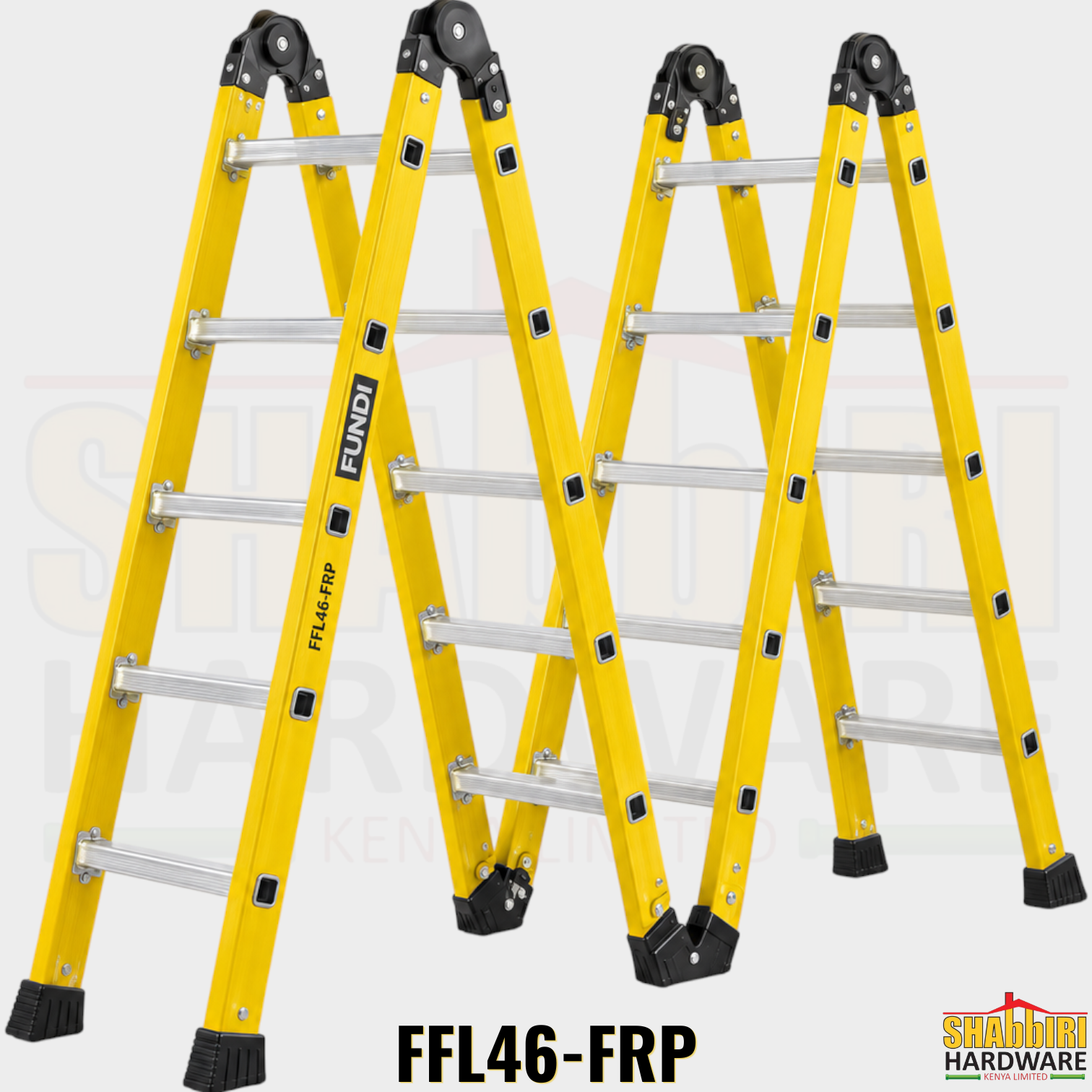
Fundi FFL46-FRP Fibreglass Folding Ladder — 4 x 6 Step Multipurpose Ladder
Fundi FFL46-FRP Fibreglass Folding Ladder — 4 x 6 Step Multipurpose Ladder (24 Rungs, 6.8 m, 150 kg) in Nairobi, Kenya
The FFL46-FRP is the largest ladder in the Fundi folding range — four hinged sections of six rungs each, built on pultruded fibreglass side rails instead of aluminium. Because the rails do not conduct electricity, it is the ladder specified for work near live conductors, switchgear, solar arrays, transformers and overhead lines. Folds down to a single carryable bundle and opens into five different working shapes.
What the Fundi FFL46-FRP 4 x 6 Fibreglass Ladder Is
"4 x 6" describes the geometry: four independently hinged sections, each carrying six rungs — 24 rungs in total. Every hinge is a heavy-duty multi-position lock, so the same ladder can be laid out straight as a 6.8-metre extension ladder, folded once into an A-frame, folded twice into a compact twin step ladder, set with uneven legs to stand safely on a staircase, or split into a two-leg trestle carrying a scaffold plank.
The "-FRP" suffix is the important part. Where the standard Fundi FFL46 uses aluminium stiles, the FFL46-FRP uses pultruded fibre-reinforced polymer — glass fibre bound in a UV-stabilised resin. FRP will not carry current, will not corrode in coastal or chemical environments, and does not soften near heat the way aluminium does. For electricians, solar installers, telecoms riggers and anyone working close to live conductors, that is not a nice-to-have; it is the reason the ladder is chosen.
Non-conductive rails
Fibreglass stiles are the recommended construction for work in the vicinity of live electrical equipment, where an aluminium ladder is a direct hazard.
Five shapes, one ladder
Extension, A-frame, twin step, stairway and trestle/scaffold — replaces several single-purpose ladders on one site.
Serrated aluminium rungs
Ribbed flat treads give grip in dust, paint and wet conditions, and stay comfortable underfoot through a long shift.
Folds for transport
Collapses to roughly 1.8 m so it rides on a pickup or roof rack instead of needing a lorry.
Corrosion-proof
No rust, no galvanic corrosion. Suited to coastal humidity, chemical plants, water treatment works and food processing.
150 kg duty rating
EN131-style rating covering the user plus tools and materials — sized for professional daily use, not occasional DIY.
Full Technical Specifications — Fundi FFL46-FRP (4 x 6 Step)
Dimensions below are the nominal figures for a 4 × 6 articulating multipurpose ladder. Small variations between production batches are normal — ask us for the current batch datasheet if a project specification requires exact figures.
| Model code | FFL46-FRP |
| Brand | Fundi |
| Product type | Four-section articulating multipurpose folding ladder |
| Configuration | 4 sections × 6 steps = 24 rungs total |
| Side rails (stiles) | Pultruded fibreglass — fibre-reinforced polymer (FRP), non-conductive, UV-stabilised resin |
| Rungs / treads | Aluminium alloy, ribbed and serrated flat tread, slip-resistant |
| Rung-to-rail joint | Mechanically swaged / riveted for a rigid, rattle-free connection |
| Hinges | 4 × heavy-duty multi-position locking hinges (typically 0° / 90° / 180° detents) |
| Feet | Non-marking anti-slip rubber or PVC end caps on all four stile ends |
| Stabiliser | Wide-base stabiliser bar for increased footprint (where supplied with the batch) |
| Colour / finish | Safety-yellow FRP rails with natural aluminium rungs |
| Parameter | Nominal figure |
|---|---|
| Length, straight / extension mode | ≈ 6.8 m (marketed in Kenya as the 24 ft ladder) |
| Height, A-frame (step) mode | ≈ 3.4 m |
| Height, twin / short step mode | ≈ 1.75 m |
| Folded transport size (L × W × D) | ≈ 1.80 m × 0.50 m × 0.22 m |
| Max working reach, straight mode | ≈ 7.6 – 7.8 m (average user, arms raised) |
| Max working reach, A-frame mode | ≈ 4.3 – 4.4 m |
| Section length (each of 4) | ≈ 1.75 – 1.80 m |
| Rung spacing (pitch) | ≈ 290 – 300 mm |
| Tread depth | ≈ 30 – 35 mm flat serrated rung |
| Outer stile width | ≈ 400 – 450 mm |
| Maximum safe working load | 150 kg — user plus tools and materials combined |
| Approximate ladder weight | ≈ 25 – 27 kg (FRP is heavier than the aluminium FFL46) |
| Construction standard | EN131 / EN131-2 style construction, professional duty |
| Working temperature range | Suitable for normal Kenyan ambient conditions; keep away from open flame and hot works |
Electrical (dielectric) performance
Fibreglass side rails are non-conductive, which is why FRP ladders are the recommended type for work near live conductors — and why an aluminium ladder should never be used for that work. Dielectric performance depends on the rails being clean, dry and undamaged: surface contamination from water, dust, metal swarf, wet paint or conductive chemicals will compromise the insulating property. Fibreglass reduces risk; it does not make live work safe on its own. Isolate and prove dead wherever the work allows, and if your job requires a certified dielectric test voltage on the certificate, ask us to confirm the rating on the current batch before you order.
How to Use the Fundi FFL46-FRP Folding Ladder — All Five Configurations
Every configuration begins the same way: on firm, level ground, with all four hinges audibly locked before any weight goes on the ladder. Work the hinges with both hands and keep fingers clear of the pivot plates.
Before every use — the 60-second check
1. Inspect the rails
Look along both fibreglass stiles for cracks, splintering, exposed white fibres or deep gouges. Fibre "blooming" means the resin has degraded — retire the ladder rather than repair it.
2. Test each hinge
Open and close all four hinges. Each must click firmly into its detent and hold without play. A hinge that will not lock takes the ladder out of service.
3. Check rungs and feet
Rungs must be tight in the rails with no rotation. All four feet must have their anti-slip caps intact — a missing cap is a slip waiting to happen.
4. Clean and dry
Wipe mud, oil, wet paint and cement dust off the rails and rungs. For electrical work this step is part of the safety system, not housekeeping.
The five working configurations
Mode 1 — Straight / extension ladder
≈ 6.8 m · reach ≈ 7.6 mFor reaching gutters, roof edges, high-level conduit, tank tops and overhead runs.
- Lay the folded ladder flat on the ground and open all four hinges to 180° until each locks straight.
- Walk the ladder up hand-over-hand, or raise it against the wall with a second person footing the base.
- Set the base so the foot is one metre out for every four metres of height — the 4:1 rule. At full 6.8 m that is roughly 1.7 m out from the wall.
- The top must rest on a solid surface and extend at least 1 m above the landing point if you are stepping off.
- Secure or foot the ladder before climbing. Tie off the top on any job lasting more than a few minutes.
Mode 2 — A-frame / double-sided step ladder
≈ 3.4 m · reach ≈ 4.4 mThe everyday shape: free-standing work on ceilings, lights, gypsum, signage and CCTV where there is no wall to lean on.
- Open all hinges straight, then fold the centre hinge down to the A-frame detent and lock it.
- Spread the legs fully until the frame is stable and both sets of feet are flat on the ground.
- Confirm the centre hinge is locked on both sides before loading.
- Climb no higher than the fourth rung from the top and never stand on the top rung.
- Keep your belt buckle inside the stiles — move the ladder rather than reaching sideways.
Mode 3 — Twin / compact step ladder
≈ 1.75 mIndoor work in tight spaces: shops, offices, corridors, kitchens, server rooms.
- Fold the outer hinges in so the ladder becomes a short, wide, double-sided step.
- Lock both hinges and check the frame does not rock.
- Ideal where the full A-frame will not fit or where headroom is limited.
Mode 4 — Stairway ladder (uneven legs)
Adjustable · staircase usePainting stairwells, changing stairwell lighting, working in split-level plant rooms.
- Fold one pair of sections into a shorter leg and leave the other pair long.
- Lock every hinge and set the short leg on the upper tread, the long leg on the lower.
- Check all four feet are bearing before climbing — no rocking on any foot.
- Keep the top of the ladder clear of the stairwell handrail so it cannot slip sideways.
Mode 5 — Trestle / scaffold with plank
Working platformContinuous horizontal work: plastering, skimming, long ceiling runs, cornice and long cable trays.
- Set the ladder into the trestle shape, or pair it with a second ladder as two supports.
- Bridge with a rated scaffold plank or staging board — never an ordinary timber offcut.
- Keep the plank span within the board's rated limit and overhang both supports adequately.
- One person on the platform at a time unless the plank and ladders are rated for more.
Safe Working Practice
Do
- Set up only on firm, level, non-slip ground.
- Confirm every hinge is locked before loading.
- Maintain three points of contact while climbing.
- Face the ladder going up and coming down.
- Apply the 4:1 rule in straight mode.
- Keep the total load — you, tools and materials — under 150 kg.
- Wear clean, dry, slip-resistant footwear.
- Use a tool belt or hoist line so both hands stay free.
- Keep the rails clean and dry, especially for electrical work.
Don't
- Don't stand on the top rung or the top cap.
- Don't over-reach — move the ladder instead.
- Don't put two people on the ladder unless it is rated for it.
- Don't use it on soft ground, loose murram, or a wet tiled floor without matting.
- Don't pack stones or bricks under a foot to level it.
- Don't use it in strong wind at full extension.
- Don't attempt repairs on cracked or splintered fibreglass — retire it.
- Don't assume FRP makes live work safe. Isolate and prove dead where you can.
Care, maintenance and storage
Clean after each job
Wipe rails and rungs with a damp cloth and mild detergent. Remove cement, paint and oil before it cures.
Keep hinges free
Brush out dust and apply a light machine oil to the pivots periodically. Never grease the rungs or rails.
Store under cover
Store flat or hung on brackets, out of permanent direct sun. UV exposure degrades resin over years.
Inspect and record
Formal inspection at least quarterly for site use, logged. Tag and withdraw any ladder that fails.
Transport secured
Strap it down on the vehicle. A ladder sliding in transit picks up the impact damage that fails it later.
Retire honestly
Cracked rails, splintered fibres or a hinge that will not lock mean the end of service life. Destroy it so it cannot be reused.
Applications for the 4 x 6 Fibreglass Multipurpose Ladder
Electrical contracting
Distribution boards, switchgear, conduit runs, street and compound lighting, generator and changeover installations.
Solar PV installation
Roof-mounted arrays, inverter and battery mounting, DC cable runs where live strings are present.
Telecoms, CCTV & networking
Camera mounting, mast and antenna work, structured cabling and access-point installation.
Building & finishing
Gypsum ceilings, cornice, painting, cladding, signage and shopfront installation.
Plant & facilities maintenance
Factories, warehouses, water treatment works, food processing and chemical stores where corrosion rules out steel.
Agriculture & greenhouses
Greenhouse frames, shade-net installation, irrigation headers, fruit harvesting and tree work.
Fundi Folding Ladder Range — Which Size Do You Need?
All Fundi folding ladders share the same four-section articulating design. The number after FFL is the section count and the rungs per section — so 4 × 6 gives the longest reach in the range.
| Model | Configuration | Total rungs | Straight length | Rail material |
|---|---|---|---|---|
| Fundi FFL43 | 4 × 3 step | 12 | ≈ 3.4 m | Aluminium |
| Fundi FFL44 | 4 × 4 step | 16 | ≈ 4.6 m | Aluminium |
| Fundi FFL44-FRP | 4 × 4 step | 16 | ≈ 4.6 m | Fibreglass |
| Fundi FFL45 | 4 × 5 step | 20 | ≈ 5.7 m | Aluminium |
| Fundi FFL46 | 4 × 6 step | 24 | ≈ 6.8 m | Aluminium |
| Fundi FFL46-FRP | 4 × 6 step | 24 | ≈ 6.8 m | Fibreglass |
Choose FRP whenever the work goes anywhere near live electrical equipment or a corrosive environment. Choose aluminium where the ladder is carried long distances all day and there is no electrical exposure — it is roughly 8 kg lighter.
Frequently Asked Questions
What does "4 x 6" mean on the FFL46-FRP?
Four hinged sections, each with six rungs — 24 rungs in total. It is the largest ladder in the Fundi folding range, opening to about 6.8 metres as a straight ladder.
How high can I actually reach with it?
About 7.6 to 7.8 metres of working reach in straight mode for an average user with arms raised, and about 4.3 to 4.4 metres in A-frame mode. Remember you should not climb higher than the fourth rung from the top in A-frame mode.
Is the fibreglass version safe for electrical work?
Fibreglass side rails do not conduct electricity, which makes FRP the recommended ladder type near live conductors — an aluminium ladder should never be used there. But the insulating property depends on the rails being clean, dry and undamaged, and it does not replace isolating and proving dead. Treat FRP as risk reduction, not a licence to work live.
How much weight can the ladder carry?
150 kg maximum safe working load. That figure covers the user plus tools and materials combined, not the user alone.
What is the difference between the FFL46 and the FFL46-FRP?
Identical geometry — same 4 × 6 layout, same 6.8 m straight length, same 150 kg rating. The FFL46 has aluminium side rails and is roughly 8 kg lighter; the FFL46-FRP has non-conductive fibreglass rails and resists corrosion. Pay for the FRP when electricity or a corrosive environment is in the picture.
Will it fit on a pickup or a roof rack?
Yes. Folded, it is roughly 1.8 m long — it travels comfortably on a pickup bed or a roof rack. Strap it down properly; impact damage in transit is what usually ends a ladder's service life.
Do you deliver in Nairobi and upcountry?
Yes. We deliver across Nairobi and arrange courier despatch countrywide. Call 0741 042484 or 0745 554008 with your delivery location for the current rate.
Do you install or fabricate?
Shabbiri Hardware is supply-only — we do not carry out installation or fabrication. We are happy to share contacts of independent installers and fundis who work with our customers regularly.
What is the price of the Fundi FFL46-FRP in Kenya?
Ladder pricing moves with import costs and stock, so we quote current pricing rather than publish a fixed figure. WhatsApp or call either branch and we will send you a written quotation the same day.
Which branch has it in stock?
We hold ladder stock at both the Ongata Rongai and Tuala branches on Magadi Road. Call ahead and we will confirm which branch has the FFL46-FRP ready for collection.
Buy the Fundi FFL46-FRP at Either Shabbiri Hardware Branch
Both branches are on Magadi Road with parking and easy loading for long items like ladders.
Ongata Rongai Branch
Magadi Road, opposite Hashi Petrol Station
Shabbiri Hardware Kenya Limited
Magadi Road, Ongata Rongai
Opposite Hashi Petrol Station, Nairobi, Kenya
📞 0741 042484 · 0745 554008
✉️ shabbirihardware@gmail.com
🌐 www.shabbirihardware.co.ke
📍 Get directions on Google Maps
Tuala Branch
Magadi Road, past Nazarene University
Shabbiri Hardware Kenya Limited
Magadi Road, Tuala
Past Nazarene University, Nairobi, Kenya
📞 0741 042484 · 0745 554008
✉️ shabbirihardware@gmail.com
🌐 www.shabbirihardware.co.ke
📍 Get directions on Google Maps
Other Ladders & Access Equipment
Specifications
| Brand | Fundi |
| Model | FFL46-FRP |
| Category | Ladders & Platforms |
| Availability | In stock |
| Sourced by | Shabbiri Hardware Kenya Limited |
Customer reviews
No reviews yet — be the first to review this product.
Frequently bought together
Customers who bought this often add these to their order.