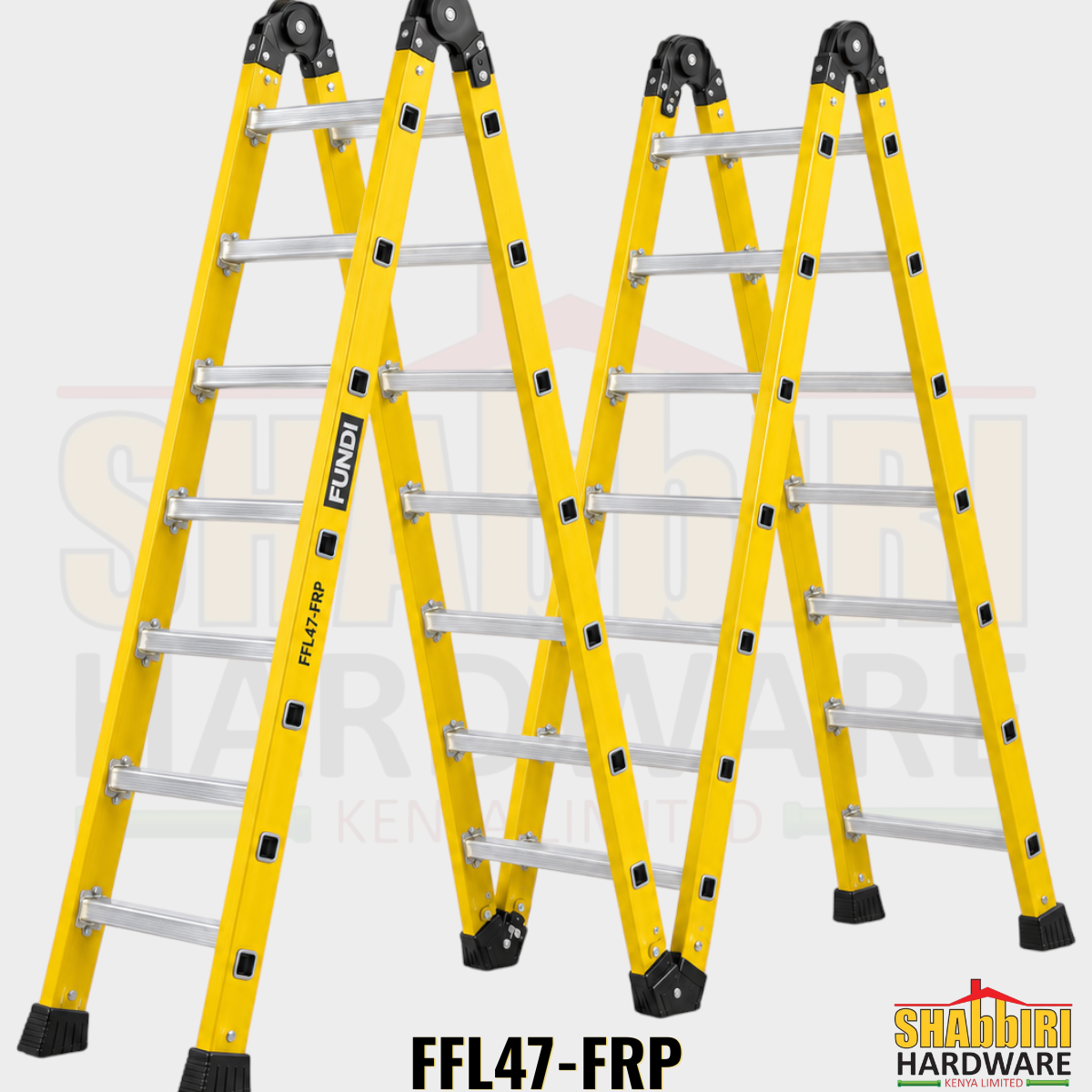
Fundi FFL47-FRP Multipurpose Fibreglass Folding Ladder – 4 x 7 Step
One Fibreglass Ladder. Four Jobs. Zero Current.
The Fundi FFL47-FRP is a 4-section articulated ladder with 7 steps per section — 28 rungs in total. Its fibreglass-reinforced polymer rails do not carry current the way aluminium does, making it the go-to ladder for electricians, solar installers, signage crews and telecom technicians.
4 Working Modes — No Tools Needed
Twin Step Ladder
A-frame, about 3.7 m high — ~5.5 m working reach.
Straight Extension
Opens to ~7.7 m for roofs, walls and poles.
Stairway Ladder
Uneven legs land level on stair treads.
Scaffold Trestle
Two ladders + a scaffold board = a work platform.
Why Pros Choose the FRP Version
Non-Conductive Safety
Right choice for work near live conductors, meter boards, street lighting and solar arrays.
Locking Hinges
Four steel hinges with spring-loaded twin pins that click at every position.
Anti-Slip Rungs
Ribbed aluminium treads spaced ~280 mm for secure footing all day.
Weather & UV Resistant
No rust or rot — built for Nairobi rains, coastal salt air and strong sun.
Folds Compact
Closes to ~2.05 m — fits roof racks, pick-ups and store shelving.
Ready Out of the Box
Supplied fully assembled. Load rating 150 kg (user + tools).
Technical Specifications
| Specification | Detail |
|---|---|
| Model | FFL47-FRP |
| Brand | Fundi |
| Configuration | 4 x 7 step (four sections, seven steps each) |
| Total rungs | 28 |
| Rail material | Fibreglass reinforced polymer (FRP), UV-stabilised |
| Rung material | Extruded aluminium alloy, ribbed anti-slip tread |
| Extended length | Approx. 7.7 m |
| A-frame height | Approx. 3.7 m |
| Folded size | Approx. 2.05 m (L) x 0.48 m (W) x 0.30 m (D) |
| Maximum load | 150 kg (user + tools/materials) |
| Weight | Approx. 27 kg |
| Duty class | Professional / heavy duty, EN 131 type |
| Hinges | 4 heavy-duty steel articulating hinges, spring-loaded locking pins |
| Colour | Yellow rails, black hinges and end caps |
| Assembly | Supplied fully assembled |
How to Set Up & Use
Inspect before use
Check rails for cracks or fibre damage, hinges close fully, pins spring back and rubber feet are intact.
Pick firm, level ground
Never on loose murram, wet tiles or stacked materials. On soft ground, stand it on a scaffold board.
Carry folded, look up
At ~27 kg, carry with two people over longer distances. Check for power lines, eaves and cables before opening.
A-frame
Squeeze the outer hinge pins, swing the outer sections down and let them click. Press on the top to test, then open the spreader bar fully.
Extension
Lock all four hinges straight. Lean at 1:4 (about 75°), extend 1 m above the landing and tie off the top.
Stairway & scaffold
On stairs, check level with a spirit level before climbing. For trestles, use proper scaffold boards and keep platforms below 2 m.
Climb safely
Face the ladder, keep three points of contact and your belt buckle between the stiles. Hoist tools in a bucket.
Store right
Fold, seat every pin, wipe off mud and cement, and store flat or hung in a dry place out of direct sun.
Care & Maintenance
Clean After Every Job
Wipe cement, paint and adhesive off the rails and rungs before it cures. Warm soapy water and a cloth is all it takes — solvents attack the resin surface.
Service the Hinges
Every few months, brush dust out of the hinge plates and put a drop of light oil on the pin springs so they seat fully. A sticky pin is the most common fault on any folding ladder.
Watch for Fibre Bloom
If the rails start to look whitened or hairy, the resin surface is weathering. A light coat of clear fibreglass lacquer restores it — never ordinary paint.
Site Safety
Do
- Confirm all four hinges are locked before putting weight on it
- Keep the fibreglass rails clean and dry to keep them insulating
- Use the 1:4 rule and tie off the top in extension mode
- Keep body weight plus tools under 150 kg
- Replace rubber feet as soon as the tread flattens
- Have a second person foot the ladder on windy or exposed sites
- Store indoors, flat or hung, out of direct sunlight
Don't
- Stand on the top two rungs of an A-frame or trestle
- Over-reach sideways — move the ladder instead
- Set it up on scaffolding, trailers or unstable surfaces
- Let two people climb one side of the A-frame
- Paint the rails — it hides cracks and fibre damage
- Use it where the job requires a certified, voltage-tested insulating ladder
- Keep using it with cracked rails, bent hinges or pins that won't seat
FFL47-FRP vs Aluminium FFL47
FFL47-FRP (Fibreglass)
- Same 4 x 7 geometry, hinges and 150 kg rating
- Non-conductive rails
- Approx. 27 kg
FFL47 (Aluminium)
- Same 4 x 7 geometry, hinges and 150 kg rating
- Conducts electricity
- Approx. 18 kg — lighter to carry
Frequently Asked Questions
How high does the Fundi FFL47-FRP reach?
About 7.7 m fully extended as a straight ladder. As a twin A-frame it stands about 3.7 m high, giving an average user a working reach of roughly 5.5 m.
Is it safe for electrical work?
FRP rails do not conduct electricity the way aluminium does, which is why electricians, solar installers and signage crews specify FRP. Keep the rails clean and dry — dirt and moisture can create a conductive path. It is a general-purpose FRP ladder, not a certified voltage-tested insulating ladder.
How much weight can it carry?
150 kg per EN 131 professional duty — that includes the user plus all tools and materials. Keep a safety margin.
Can one person carry it?
A strong person can move the ~27 kg ladder short distances, but carry it with two people over longer distances, on stairs or in wind. The aluminium FFL47 (~18 kg) is lighter if you don't need non-conductive rails.
Do you deliver outside Nairobi?
Yes. Same-day delivery within Nairobi and next-day countrywide — including Kajiado, Ngong, Kiserian, Karen and Kitengela — by courier or matatu parcel. Call us for a delivery quote.
Does it need assembly or installation?
No — it arrives fully assembled. We are supply-only, but our team can share contacts of independent fundis and installers on request.
Do you offer contractor or bulk pricing?
Yes. We send formal quotations for contractor and bulk orders, usually the same day — for contractors, county projects, schools, hotels, factories and facilities teams.
Order the Fundi FFL47-FRP Today
In stock at both branches. Free pickup, or same-day delivery within Nairobi.
Specifications
| Brand | Fundi |
| Model | FFL47-FRP |
| Category | Ladders & Platforms |
| Availability | In stock |
| Sourced by | Shabbiri Hardware Kenya Limited |
Customer reviews
No reviews yet — be the first to review this product.
Frequently bought together
Customers who bought this often add these to their order.