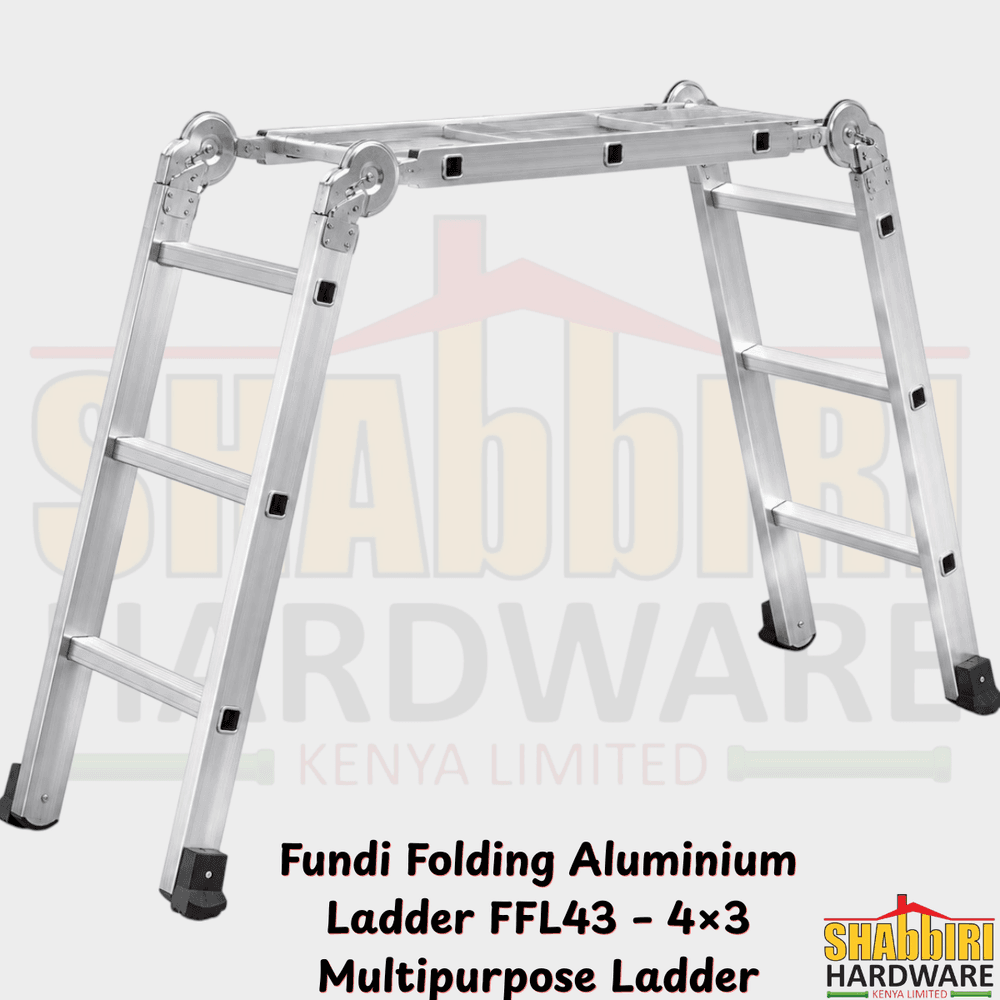
Fundi Folding Aluminium Ladder FFL43 – 4 x 3 Step Multipurpose Ladder (3.5m Reach, 150kg)
A four-section, twelve-rung articulated aluminium ladder that converts from a straight 3.5-metre extension ladder to an A-frame step ladder, a stair ladder or a working platform — then folds down to under a metre for the boot of a car. Stocked at both Shabbiri Hardware branches on Magadi Road, Ongata Rongai and at Tuala past Africa Nazarene University.
Product Overview
The Fundi Folding Aluminium Ladder FFL43 is a multipurpose articulated ladder built around four hinged aluminium sections of three rungs each — twelve rungs in total. Each of the three hinges is a locking joint that snaps and holds at fixed angles, so a single ladder replaces the step ladder, the straight extension ladder and the trestle you would otherwise buy separately.
It is the ladder most suited to painters, electricians, signage crews, solar and DSTV installers, plumbers, shopfitters, facility maintenance teams and homeowners working on single- and double-storey buildings. In its straight position it reaches roof eaves and gutters on a typical maisonette; in its A-frame position it stands unsupported in the middle of a room for ceiling boards, lighting and gypsum work; and in trestle mode two ladders and a scaffold plank give a stable working platform for painting a long wall.
Key Features at a Glance
- Four-way convertible: straight extension ladder, A-frame step ladder, stair/uneven-ground ladder and trestle scaffold base.
- Triple locking hinges with twin spring-loaded release buttons on each joint — the ladder cannot fold under load once the pins are seated.
- Serrated, slip-resistant rungs that stay grippy in dust, in light rain and under paint-splashed boots.
- Wide anti-slip end caps on all four feet to protect tiled and terrazzo floors and to bite on murram and concrete.
- 150 kg (approx. 330 lb) rated duty — comfortably carries an operator plus a tool belt and a paint pot.
- Riveted and swaged rung-to-stile joints for rigidity without welding stress points.
- Folds to under 1 metre for one-person transport and compact storage.
Full Technical Specifications — Fundi FFL43
| Brand | Fundi |
|---|---|
| Model number | FFL43 |
| Product type | Multipurpose articulated folding ladder (4-in-1) |
| Configuration | 4 sections × 3 steps — 12 rungs total |
| Frame material | Aluminium alloy (6061/6063 grade), anodised finish |
| Hinge / joint material | Zinc-plated steel locking hinges with spring-loaded pins |
| Number of hinges | 3 multi-position locking joints |
| Hinge lock angles | Typically 0°, 90°, 180° (straight, right-angle and A-frame detents) |
| Extended (straight) length | Approx. 3.4 – 3.5 m |
| A-frame / step ladder height | Approx. 1.7 – 1.75 m |
| Working reach (straight, arms up) | Approx. 4.3 – 4.5 m |
| Folded length | Approx. 0.9 – 0.95 m |
| Folded width | Approx. 0.40 – 0.45 m |
| Folded thickness (packed) | Approx. 0.18 – 0.22 m |
| Rung spacing (pitch) | Approx. 280 – 300 mm |
| Rung profile | Flat/oval serrated tread, slip-resistant |
| Rung width (step depth) | Approx. 30 – 35 mm |
| Stile (side rail) section | Rectangular aluminium tube, approx. 1.0 – 1.2 mm wall |
| Maximum load capacity | 150 kg (approx. 330 lb), single user |
| Nett weight | Approx. 11 – 13 kg |
| Feet | 4 × wide non-marking anti-slip PVC/rubber end caps |
| Finish | Natural anodised aluminium, corrosion resistant |
| Design standard | Manufactured to EN 131 multipurpose ladder design principles |
| Working positions | Straight extension • A-frame step • Stair / uneven ground • Trestle scaffold base |
| Recommended use | Trade and heavy domestic — painting, electrical, plumbing, signage, solar & aerial installation, ceiling and gypsum work, maintenance |
| Assembly required | None — supplied ready to unfold |
| Country of origin | Confirm on carton label |
| Warranty | Manufacturer defect warranty — see in-store terms |
Note on dimensions: figures above describe the standard 4 x 3 step multipurpose configuration. Exact millimetre dimensions, nett weight and the certification marking printed on your consignment should be confirmed against the carton label or the manufacturer’s data sheet before publishing final specifications.
The Four Working Positions
1. Straight Extension Ladder
All three hinges locked flat at 180°, giving a single 3.5 m run for roof eaves, gutters, external walls, signage and aerial work. Lean at the correct 75° angle.
2. A-Frame Step Ladder
Centre hinge opened, outer hinges locked flat. Free-standing at roughly 1.7 m for ceiling boards, downlights, curtain rails and stock picking — no wall required.
3. Stair / Uneven Ground Ladder
Outer hinges dropped to 90° so the two front legs sit on a lower step or slope while the ladder stays level. Ideal for stairwells and sloping compounds.
4. Trestle / Scaffold Base
Opened flat into a low double-trestle. Pair two units with a certified scaffold plank between matching rungs to create a working platform for long walls and ceilings.
How to Use the Fundi FFL43 Folding Ladder
Before every use — the 60-second check
- Stand the folded ladder on level ground and look along each stile for bends, dents, cracks or corrosion. A bent stile takes the ladder out of service permanently.
- Press each hinge release button in and out. It must spring back sharply and the pin must seat fully. A sticky hinge gets a light spray of penetrating oil; a hinge that does not seat is a scrap ladder.
- Check all twelve rungs are tight in their stiles — no rattle, no rotation, no loose rivets.
- Check all four feet still have their anti-slip caps and that the caps are not worn smooth, split or clogged with cement.
- Wipe grease, mud, wet paint or oil off the rungs and off the soles of your boots.
Setting up as a straight extension ladder
- Lay the ladder flat on the ground with the feet against the base of the wall.
- Press both release buttons on each hinge and swing the sections out until all three joints click flat at 180°. Tug each joint to confirm the pins are locked.
- Walk the ladder upright hand over hand, then place it against the wall at the 1-in-4 rule: the foot sits one metre out from the wall for every four metres of ladder height — about 75°. At full 3.5 m extension the feet should be roughly 0.85 m out.
- Ensure the ladder extends at least 1 metre (about 3 rungs) above any roof edge or platform you intend to step onto.
- Have a second person foot the ladder, or tie the stiles off at the top, before climbing.
Setting up as an A-frame step ladder
- Lock the two outer hinges flat at 180° so each half is a rigid six-rung run.
- Release the centre hinge and open the ladder into an A until the centre joint locks at its A-frame detent.
- Set it on firm, level ground with all four feet in contact. Never bridge a step, a plank or loose blocks to level it.
- Climb no higher than the third rung from the top and never stand on or straddle the top hinge.
- Keep your belt buckle between the stiles at all times — move the ladder rather than over-reaching.
Setting up on a staircase or sloping ground
- Lock the centre hinge flat at 180°.
- Drop the outer hinge on the downhill side to its 90° detent so the lower legs reach the lower step or the fall of the slope.
- Adjust until the rungs you will stand on are visibly horizontal, then load-test with your hands and one foot before committing your weight.
Using as a trestle scaffold
- Open two FFL43 ladders flat into low trestles, positioned no more than the plank manufacturer’s maximum span apart.
- Bridge them with a certified scaffold plank or staging board — never a random timber board or a door.
- Seat the plank on matching rungs on both ladders so it is level, and let it overhang each support by at least 150 mm.
- Keep the platform low, one worker per plank span unless the plank is rated for more, and never join two planks over one rung.
Folding and storing
- Bring the ladder to the ground before releasing any hinge.
- Press both buttons on a joint at once and fold the section, keeping fingers clear of the closing scissor gap — this is the single most common injury with articulated ladders.
- Fold all sections together and store the ladder flat or hung horizontally on wall brackets, indoors, out of the rain and away from cement dust and acids.
- Every few months, wipe the ladder down and put a drop of light oil in each hinge to keep the pins free.
Safety Warnings — Read Before First Use
- Aluminium conducts electricity. Never use this ladder near live overhead lines, exposed conductors or any live electrical installation. Use a fibreglass ladder for live electrical work.
- Confirm every hinge is locked before you put weight on the ladder. A partially seated pin will collapse under load.
- Do not exceed 150 kg total — that is you, your clothing, your tools and your materials combined.
- One person at a time. Only the trestle configuration with a certified plank supports more than one worker, and only within the plank’s own rating.
- Maintain three points of contact while climbing — two hands and a foot, or two feet and a hand. Carry tools in a belt or hoist them with a line.
- Face the ladder going up and coming down. Never descend backwards.
- Do not use in strong wind, on ice, on wet smooth tiles, or on soft or loose ground without a base board.
- Do not lean the ladder against a window pane, a gutter, a corrugated sheet or any unstable surface.
- Do not modify, drill, weld or paint over the stiles — paint hides cracks and voids the warranty.
- Retire the ladder immediately after any fall, impact or visible deformation.
Who the FFL43 Is Built For
- Painters and decorators — A-frame for ceilings, trestle for long walls, straight for external fascia.
- Electricians and solar installers — roof access and conduit runs (on dead circuits only).
- DSTV, aerial and CCTV technicians — fits in a saloon boot between jobs.
- Plumbers and HVAC crews — overhead tank, gutter and duct work.
- Signage and branding teams — shopfront fascia at 3–4 m.
- Facility and estate maintenance — bulb changes, gutter cleaning, security light servicing.
- Homeowners — one ladder that covers the ceiling, the stairwell and the roofline.
Frequently Asked Questions
What does “4 x 3 step” mean on the FFL43?
It describes the ladder’s construction: four hinged aluminium sections, each carrying three rungs, for twelve rungs in total. Opened straight it forms a single ladder of about 3.4–3.5 metres; folded into an A-frame it stands at about 1.7 metres.
How high can I reach with the Fundi FFL43?
In the straight position the ladder is about 3.5 m, which gives a practical working reach of roughly 4.3–4.5 m with your arms raised — enough for the eaves and gutters of most single-storey and many two-storey Kenyan homes.
How much weight does it carry?
150 kg, which is the combined weight of the user plus tools and materials. It is a single-user ladder in all positions except the trestle configuration with a certified scaffold plank.
Will it fit in my car?
Yes. Folded it measures roughly 0.9 m long by 0.45 m wide, so it fits in the boot of most saloons with the rear seats folded, and easily into any pickup, van or station wagon.
Is it safe for electrical work?
Only on isolated, dead circuits. Aluminium conducts electricity, so for live electrical work or any job near overhead power lines you should use a fibreglass ladder instead. Ask us in-store and we will point you to the right option.
What is the price of the Fundi FFL43 folding ladder in Kenya?
Call or WhatsApp 0741 042484 or 0745 554008 for today’s price and current stock. Contractors, hardware resellers and institutions buying in quantity should ask for our trade rate.
Do you deliver?
Yes. Same-day delivery around Ongata Rongai, Tuala, Kiserian, Ngong, Karen, Langata and Nairobi, and countrywide dispatch through courier and parcel services.
Where can I buy this ladder in Ongata Rongai?
At Shabbiri Hardware, Magadi Road, Ongata Rongai, and at our Tuala branch just past Africa Nazarene University. Both branches stock the FFL43 and the rest of our ladder and access equipment range.
Where to Buy — Shabbiri Hardware Branches
Rongai Branch
Magadi Road, Ongata Rongai, Kajiado County, Kenya
Tuala Branch
Tuala, Magadi Road — past Africa Nazarene University, Kajiado County, Kenya