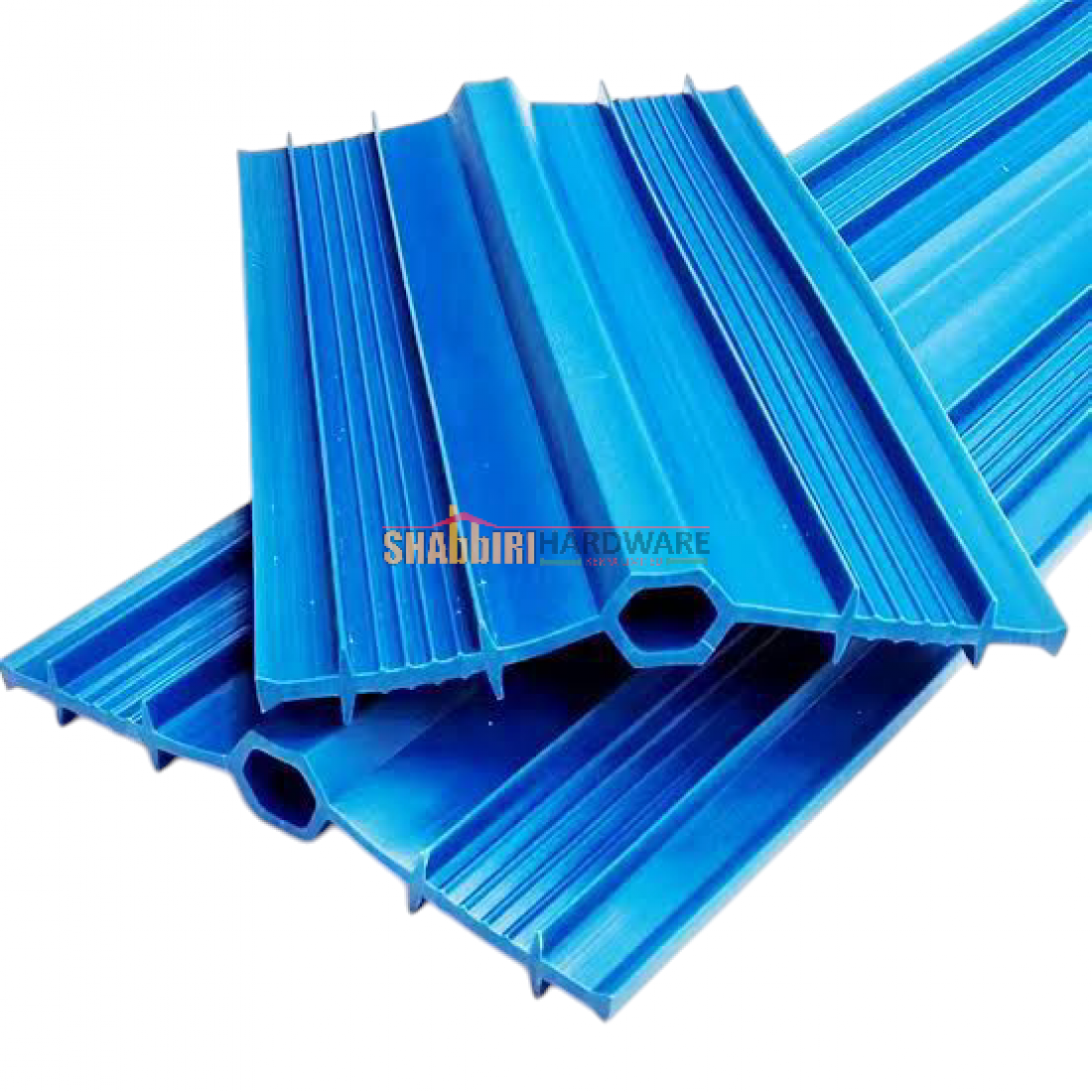
WATER BAR - CENTRE BULB 250mm x 25mtr
Centre Bulb Water Bar 250mm x 25m – Stop Water Leaking Through Concrete Joints
A heavy-duty PVC waterstop that is cast into concrete at construction and expansion joints, forming a permanent barrier that water cannot pass through. Ideal for water tanks, basements, swimming pools, culverts and retaining walls in Nairobi and across Kenya.
What is a water bar?
Concrete is poured in sections, and every place where one section meets the next (a joint) is a weak point where water can seep through. A water bar (also called a waterstop) is a flexible PVC strip placed inside the joint before the concrete is poured. Half of it is embedded in the first pour and half in the second, so water trying to pass through the joint is blocked by the PVC.
This centre bulb type has a hollow tube running down the middle. The bulb sits exactly on the joint and stretches or squeezes as the concrete expands, contracts or settles – so the seal stays watertight even when the joint moves. The ribbed flanges on both sides grip the concrete firmly so the bar cannot be pulled out.
Technical details
| Product | Water Bar – Centre Bulb (PVC Waterstop) |
|---|---|
| Width | 250 mm |
| Roll length | 25 metres |
| Profile | Centre bulb with ribbed flanges and end grip edges |
| Material | Flexible PVC (polyvinyl chloride) |
| Colour | Blue |
| Joint type | Expansion joints and construction joints (moving and non-moving) |
| Installation position | Internal – cast into the middle of the concrete section |
| Jointing method | Heat welding (butt-welded ends) |
| Typical tensile strength | ≥ 12 N/mm² |
| Typical elongation at break | ≥ 300% |
| Typical hardness | Shore A 70 – 80 |
| Resistance | Water, alkalis in concrete, soil, mild chemicals; does not rot or rust |
| Price | KSh 38,000 per roll |
Values marked "typical" are standard figures for PVC waterstops. Ask us for the manufacturer's data sheet if your engineer needs certified values.
Why this water bar works
Hollow centre bulb
Absorbs joint movement – expansion, shrinkage and settlement – without tearing.
Ribbed flanges
Multiple ribs lock into the concrete and lengthen the path water must travel.
Grip edges
Thickened outer edges anchor the bar and make it easy to tie to reinforcement.
Wide 250mm profile
Suits walls and slabs carrying high water pressure, such as tanks and basements.
Flexible PVC
Bends around corners and holds its seal; does not rust, rot or corrode.
Heat-weldable
Lengths and corners are joined by heat welding into one continuous seal.
How much do you need?
Simple rule: add up the total length of all joints that need sealing (wall-to-floor kicker joints, wall-to-wall joints and expansion joints), add about 5–10% extra, then divide by 25 to get the number of rolls.
Example: a water tank measuring 6m x 4m has a floor-to-wall joint running around the perimeter: 6 + 4 + 6 + 4 = 20 m. Add 10% = 22 m → 1 roll.
What you gain
- Leak-free structures – stops water seeping through joints in tanks, basements, pools and foundations.
- Protects the steel – keeps water away from reinforcement bars, preventing rust and concrete cracking.
- Handles movement – the centre bulb keeps sealing even when concrete expands, shrinks or settles.
- Permanent, hidden protection – cast inside the concrete, so it is not exposed to sun, traffic or damage.
- Saves repair costs – far cheaper to install during construction than to fix leaks later.
- Long service life – PVC does not rot or corrode in wet ground or stored water.
Step-by-step installation
- Plan the joint. Mark where every construction and expansion joint will be. The water bar must run continuously through all of them with no gaps.
- Set up split formwork. Use stop-end formwork split in two halves so the water bar can pass through the middle. Half the width (125mm) goes into the first pour, half into the second.
- Centre the bulb. Position the hollow centre bulb exactly on the joint line. For expansion joints, the bulb should sit in line with the joint filler board.
- Fix it firmly. Tie the grip edges to the reinforcement with binding wire about every 300mm so the bar stays straight and does not fold or move during pouring. Never nail through the flanges.
- Join lengths by heat welding. Cut ends square and butt-weld them using a heated splicing iron. Do not simply overlap or glue pieces – that leaves a leak path.
- Pour and compact carefully. Pour concrete evenly on both sides. Vibrate well around the flanges to remove air pockets, but keep the vibrator from touching the water bar.
- Prepare for the second pour. After striking the formwork, clean the exposed half of any concrete, mud or oil, check it is undamaged, and fold it straight before casting the next section.
Where to use it – and tips for best results
Common uses: underground and above-ground water tanks, reservoirs, swimming pools, basements, lift pits, sewage and treatment plants, culverts, bridges, dams, retaining walls and foundation slabs.
Do
- Store rolls in the shade, away from sun and sharp objects.
- Keep the bar clean before concreting.
- Make all corners and junctions with welded pieces.
- Use the centre bulb type where joints will move.
- Check alignment just before each pour.
Don't
- Don't puncture the flanges with nails or wire holes.
- Don't overlap pieces without welding.
- Don't let the bar fold flat against the formwork.
- Don't leave it exposed to sunlight for long periods.
- Don't pour concrete from height directly onto it.
Order Your Water Bar Today
In stock at both branches. Delivery same-day within Nairobi and next-day countrywide. Installer contacts available on request.
Pay via M-Pesa Paybill 542 542, Account 78653
Our Branches
Ongata Rongai Branch
Magadi Road, opposite Hashi Petrol Station
Specifications
| Model | CB250 |
| Category | Waterproofing & Sealants |
| Availability | In stock |
| Sourced by | Shabbiri Hardware Kenya Limited |
Customer reviews
No reviews yet — be the first to review this product.
Frequently bought together
Customers who bought this often add these to their order.


