Shade Net 90% Black (Privacy Screen) – 25m x 3m Heavy Duty UV HDPE Fence & Site Netting, 75 Sqm Roll
Shade Net 90% Black (Privacy Screen) — 25m x 3m Roll
Heavy-duty, UV-stabilised black HDPE privacy shade netting that blocks up to 90% of sunlight, dust and prying eyes. One 25-metre roll covers 75 square metres — enough to screen a full plot boundary, construction hoarding, car port, balcony or nursery in a single afternoon. Stocked at both Shabbiri Hardware branches in Ongata Rongai and Tuala.
Why contractors and homeowners choose the 90% black net
Ninety percent is the highest practical shade grade sold in Kenya for general fencing and screening. Below it you get shade; at 90% you get shade and genuine visual privacy.
Shade Net 90% Black Privacy Screen — 25m x 3m (75 sqm roll)
A dense, warp-knitted black shade netting engineered for privacy fencing, construction hoarding, sun control and wind reduction across Nairobi, Kajiado and the wider Rift Valley.
The Shade Net 90% Black (Privacy Screen) 25m x 3m is manufactured from virgin high-density polyethylene (HDPE) tape and monofilament yarn that is UV-stabilised throughout the polymer — not sprayed on the surface — so the mesh resists the intense equatorial ultraviolet radiation experienced at Nairobi's 1,700 m altitude. The yarn is warp-knitted (Raschel knit) with a lock-stitch construction, which is the single most important quality marker in a shade net: unlike woven or extruded nets, a lock-stitched knit will not unravel, run or ladder when you cut it to length or when a strand is torn by wind or a stray nail.
At a 90% shade factor, the mesh is dense enough that a person standing one metre away cannot make out detail behind it, while still allowing roughly 10% of light and a controlled amount of air to pass through. That air permeability is what separates a shade net from a solid tarpaulin or an iron sheet hoarding: wind passes through instead of pushing against it, so posts and fixings take a fraction of the load and the screen survives storms that flatten solid barriers. Black is the preferred colour for privacy applications because it absorbs rather than scatters light, giving the deepest visual block and the least "see-through" effect in bright sun.
Each roll is supplied 25 metres long by 3 metres wide, giving 75 square metres of coverage — the standard boundary-screening roll size in Kenya. Three metres of height is the sweet spot for plot boundaries, construction site hoarding and car ports; for taller runs two rolls can be overlapped by 100–150 mm and stitched or cable-tied along the seam.
90% sun & glare block
Cuts direct solar radiation by nine-tenths, dropping surface temperatures under a car port or verandah by 8–15°C on a hot Rongai afternoon.
True visual privacy
Dense black knit stops neighbours, passers-by and roadside traffic from seeing into your compound, pool area or site.
Wind & dust filter
Breaks wind speed by up to 70% and traps airborne dust and murram — ideal for sites, nurseries and boundary walls near the Magadi Road.
Lock-stitch — cut anywhere
Raschel lock-knit means no fraying or unravelling when you trim to size on site. No hemming required.
Rot & chemical proof
HDPE does not absorb water, rot, rust or mildew. Unaffected by fertilisers, cement dust, lime and most site chemicals.
Cheapest privacy per metre
A fraction of the cost of a masonry wall, timber hoarding or iron sheets — and reusable when the job moves.
Technical data sheet
Typical values for the Shabbiri Hardware 90% black privacy shade net. Minor variation between production batches is normal and within trade tolerance.
| Specification | Value / Detail |
|---|---|
| Product name | Shade Net 90% Black — Privacy Screen / Fence Net |
| Product code (SKU) | SHB-SN90-BLK-25X3 |
| Shade factor / density | 90% (±3%) light interception |
| Light transmission | Approximately 10% |
| Privacy rating | High — near-opaque at 1 m viewing distance |
| Colour | Black (UV carbon-black pigmented) |
| Raw material | 100% virgin HDPE (high-density polyethylene), UV-stabilised in the melt |
| Yarn type | Flat tape yarn with monofilament binder |
| Construction | Warp-knitted Raschel lock-stitch — non-fray, non-ravel when cut |
| Fabric weight (GSM) | 150 – 180 g/m² (heavy duty grade) |
| Roll length | 25 metres |
| Roll width | 3 metres |
| Coverage per roll | 75 m² (807 sq ft) |
| Approximate roll weight | 11 – 13.5 kg |
| Packed roll diameter | Approx. 250 – 300 mm, 3 m long |
| Selvedge / edges | Reinforced lock-stitched selvedge on both long edges |
| Eyelets | Optional — brass/aluminium grommets can be fitted on request at 500 mm centres |
| UV stabilisation | UV masterbatch additive throughout; resists photo-degradation |
| Expected service life | 3 – 5 years continuous outdoor exposure in Kenyan conditions |
| Tensile strength (warp) | Approx. 900 – 1,200 N per 50 mm strip |
| Tensile strength (weft) | Approx. 700 – 950 N per 50 mm strip |
| Elongation at break | 25 – 40% |
| Air permeability | Approx. 10 – 15% open area — wind passes through, reducing load on posts |
| Wind load reduction | Up to 70% wind-speed reduction downstream of the screen |
| Temperature resistance | -40°C to +100°C without embrittlement |
| Water absorption | Nil — HDPE is hydrophobic; net does not hold water weight |
| Chemical resistance | Resistant to fertilisers, lime, cement, most acids and alkalis |
| Rot / mildew / rust | Fully resistant — no rotting, no rusting, no fungal growth |
| Fire behaviour | Standard grade is NOT fire retardant. FR grade available on special order |
| Recyclability | 100% recyclable HDPE (resin code 2) |
| Cutting | Scissors, sharp knife or hot-knife. Hot-knife seals the edge permanently |
| Fixing methods | UV cable ties, shade-net clips, poly baler twine, batten strips, hog rings |
| Other sizes stocked | Also available in 50m x 3m and 50m x 4m rolls, and in green 70% / 80% / 90% |
| Origin | Imported — supplied and warranted by Shabbiri Hardware, Kenya |
Shade factor comparison — which percentage do you need?
| Shade % | Privacy level | Best used for |
|---|---|---|
| 30 – 50% | Very low | Nurseries, hardening-off seedlings, light crop shading, poultry runs |
| 60 – 70% | Low to medium | Vegetable shade houses, patios, general garden shade, car park shade |
| 80% | Medium-high | Car ports, verandahs, kennels, partial fence screening |
| 90% (this product) | High — recommended for privacy | Boundary privacy fencing, construction hoarding, pool screening, balcony screens, site security screening |
| 95%+ / solid | Total | Blackout drying sheds, mushroom houses — traps heat, not recommended for fences |
Where the 90% black privacy net is used
One roll, many jobs — from Nairobi construction sites to Rongai homesteads.
Construction site hoarding
Wrap scaffolding and site perimeters to contain dust and debris, hide the works and meet county site-screening expectations. Lighter and faster than iron sheets.
Plot boundary privacy fence
Fix to chain-link, weld-mesh or timber posts to instantly stop neighbours seeing into your compound while the hedge grows.
Car ports & parking shade
Keeps vehicle interiors dramatically cooler and protects paintwork from UV chalking and bird droppings.
Swimming pool & patio screening
Private pool area, less wind chill on the water surface and fewer leaves blown in.
Balcony & terrace screens
Apartment balconies in Rongai, Kileleshwa and Syokimau — privacy from opposite blocks plus afternoon sun control.
Poultry & livestock curtains
Side curtains for poultry houses, calf pens and dairy sheds — shade and draught control without blocking ventilation.
Nursery & drying yards
Deep shade for tissue-culture hardening, seedling nurseries, coffee/tea drying yards and cut-flower packhouse walkways.
Events & funeral tents
Instant side walls and screening for tents, exhibition stands, church grounds and burial sites.
Kennels & sports fencing
Shade for dog runs; ball-stop and glare screening behind goals and courts.
How to install the 90% black shade net privacy screen
A 25m x 3m roll can be fitted by two people in two to three hours on an existing chain-link fence. Here is the method our customers use.
Tools and materials you will need
Fixings
UV-stabilised black cable ties (200 mm / 300 mm), shade-net clips or hog rings, galvanised binding wire, or poly baler twine. Budget roughly 3–4 ties per running metre per fixing line.
Structure
Chain-link or weld-mesh fence, 50 mm galvanised posts, timber posts (100 x 50), or 4 mm straining wire runs at top, middle and bottom.
Hand tools
Tape measure, sharp knife or heavy scissors (or a hot-knife), side-cutters, spirit level, gloves, and a ladder. A staple gun and batten strips if fixing to timber.
Step-by-step installation
Measure the run and plan the roll
Measure the total length to be screened and add 5% for tensioning and overlaps. One roll covers 25 running metres at 3 m high. For a 40 m boundary you need two rolls.
Prepare the supporting structure
Posts at maximum 2.5–3 m centres. Run 4 mm straining wire along the top, middle and bottom of the run and tension it — the net follows the wire, the wire carries the load. Never rely on the net alone to span between posts.
Unroll along the fence line
Lay the roll on the ground parallel to the fence and unroll the full length before lifting. Keep the net off sharp stones and off freshly cut wire ends.
Fix the top edge first
Lift one end, align the top selvedge 25–50 mm above the top wire, and tie off every 300–500 mm working along the run. Always fix through the reinforced selvedge, not through the middle of the mesh.
Tension as you go
Pull horizontally hand-tight — firm but not stretched. Over-tensioning tears the knit at the fixing points; under-tensioning lets the net flap and abrade. A slight, even drape is correct.
Fix the bottom and middle lines
Secure the bottom edge to the bottom wire or to a ground rail so wind cannot get underneath and balloon the screen. Add a middle line of ties on runs over 2 m high.
Cut and join
Trim with a sharp knife or hot-knife — the lock-stitch will not unravel. Join two rolls by overlapping 100–150 mm and cable-tying or stitching every 200 mm along the seam.
Finish the corners and gates
Wrap corners continuously rather than cutting and butting. At gates, fix a timber batten along the leading edge to stop flapping and fraying at the swing side.
Fixing to different structures
| Structure | Recommended method |
|---|---|
| Chain-link fence | UV cable ties or hog rings through the selvedge into the link, every 300–400 mm on three lines (top, middle, bottom) |
| Weld mesh panels | Cable ties every 400 mm around the horizontal wires; run a batten at the top for a clean line |
| Timber posts / rails | Sandwich the net between the post and a 25 x 50 mm timber batten, screw or nail through — never staple bare mesh alone |
| Steel / GI posts only | Install 4 mm straining wire top, middle and bottom between posts first, then tie the net to the wires |
| Balcony railing | Cable ties through the selvedge at 250 mm centres; add eyelets for a neater finish and easy seasonal removal |
| Car port / overhead shade | Fit eyelets at 500 mm centres and lace to the frame with rope; leave a 10% sag for rain runoff and wind relief |
| Scaffolding | Tie to every standard and ledger; leave the bottom 300 mm free to vent, and inspect ties weekly |
✅ Do
- Fix through the reinforced selvedge and along tensioned wires.
- Use black UV-stabilised cable ties — clear or coloured ties perish within months.
- Overlap joins by at least 100 mm and tie both edges.
- Leave a small, even drape rather than drum-tight tension.
- Wash off cement splashes and murram dust with plain water.
- Store spare net rolled, dry and out of direct sun.
❌ Don't
- Don't nail or staple directly through bare mesh — use a batten.
- Don't stretch the net drum-tight; the knit will tear at the fixings.
- Don't leave the bottom edge loose — wind will balloon and rip it.
- Don't fix over sharp cut wire ends, rough blockwork or nail heads.
- Don't use it near open flame, welding sparks or grinder sparks (not fire retardant).
- Don't expect it to be waterproof — it is a screen, not a tarpaulin.
Care, maintenance and lifespan
The net needs almost no maintenance. Hose it down with plain water once or twice a year to clear dust and cement film — a clean net looks better and lasts longer because trapped grit abrades the yarn. Inspect the ties after every heavy storm and replace any that have snapped; a single failed tie lets the net flap and can destroy a metre of edge in one windy week. Small tears can be repaired on site by stitching with poly twine or by cable-tying a patch of offcut over the hole. Handled this way, the screen will give three to five years of continuous outdoor service, and considerably longer if it is taken down and stored between seasons or between projects.
How many rolls do you need?
Each 25m x 3m roll screens 25 running metres at 3 metres high, or 37.5 running metres at 2 metres high if you cut the width down the middle.
| Job | Typical run | Rolls of 25m x 3m |
|---|---|---|
| 50 x 100 ft plot boundary (full perimeter) | Approx. 92 running metres | 4 rolls |
| Single boundary side of a 50 x 100 plot | Approx. 30 running metres | 2 rolls |
| Quarter-acre perimeter | Approx. 128 running metres | 6 rolls |
| Double car port (6 m x 6 m roof + one side) | Approx. 54 m² | 1 roll |
| Apartment balcony screen (4 m x 1.2 m) | Approx. 5 m² | Cut from 1 roll (ask for a cut length) |
| Construction site hoarding, 3 m high | Per 25 m of hoarding | 1 roll per 25 m |
| Poultry house side curtains (both sides, 20 m house) | Approx. 40 running metres at 1.5 m | 1 roll (cut the 3 m width in half) |
Cut lengths: we also sell this net by the metre off the roll at both branches, so you can buy exactly what a small balcony or gate screen needs instead of a full 25 m roll. Bring your measurements — or send them on WhatsApp — and we will work out the quantity and give you a written quotation on the spot.
Trade & bulk: contractors, farms, schools, greenhouses and county projects get tiered pricing from three rolls upward, with delivery to site across Nairobi, Kajiado, Ngong, Kiserian, Kitengela and Kikuyu. Ask for our contractor price list.
Shade Net 90% Black — your questions answered
What is the price of a 90% black shade net 25m x 3m in Kenya?
Shade net prices move with the exchange rate and import duty, so we quote live rather than publish a fixed figure. Call 0741 042484 or 0745 554008, or WhatsApp us, and we will give you today's price per roll and per metre, plus contractor rates from three rolls upward. Both Ongata Rongai and Tuala branches quote the same price.
Is a 90% shade net completely private?
It gives high privacy but is not 100% opaque. From about a metre away, shapes and movement may be faintly visible from the brighter side towards the darker side, but detail is not. For boundary walls, pool areas, balconies and site hoarding, 90% black is the grade almost everyone chooses. If you need total blackout, ask about our 95% and solid PVC screening.
Why black instead of green for privacy?
Black absorbs light rather than scattering it, so it reads as a solid dark surface and gives the deepest visual block. Green looks softer against a garden and is popular for hedging effect, but at the same shade percentage black always looks more private. We stock both — green 70%, 80% and 90%, and black 80% and 90%.
Is the net waterproof?
No. It is a breathable screen, not a tarpaulin. Rain passes through, which is deliberate — it stops water pooling and tearing the net down. If you need a waterproof cover, ask for our PVC tarpaulins or clear polythene sheeting.
How long will it last in the Kenyan sun?
Three to five years of continuous outdoor exposure when correctly installed, because the UV stabiliser is compounded into the polymer rather than coated on the surface. Nets that fail early almost always fail at the fixings — over-tensioned, tied with non-UV ties, or left flapping at a loose bottom edge.
Can I cut it without it fraying?
Yes. The Raschel lock-stitch construction means cut edges do not unravel or ladder. Use a sharp knife or heavy scissors. A hot-knife (or briefly running a flame along the cut) fuses the edge for the neatest finish.
Can it be used as a greenhouse or nursery cover?
Yes, but check the crop. 90% is very deep shade — right for hardening tissue-culture plantlets, mushroom houses, drying yards and walkways. For most vegetables and flowers you want 30–70%, which we also stock.
Do you fit eyelets?
Yes, brass or aluminium grommets can be fitted at 500 mm centres on request. Eyelets are worth it for overhead car-port shades and for balcony screens you plan to remove seasonally; for chain-link fencing, cable ties through the selvedge are faster and cheaper.
Is it fire retardant?
The standard grade is not. Keep it well away from welding, angle grinders, cooking fires and generator exhausts. A fire-retardant grade can be brought in on special order for sites that require it — give us about two weeks.
Do you deliver, and do you accept M-Pesa?
Yes to both. Delivery is free within Ongata Rongai, Tuala, Kiserian and Ngong, and available at cost across Nairobi, Kajiado, Kitengela, Kikuyu and upcountry via courier or matatu parcel. We accept M-Pesa, cash, bank transfer and cheque for approved accounts.
What other sizes and grades do you stock?
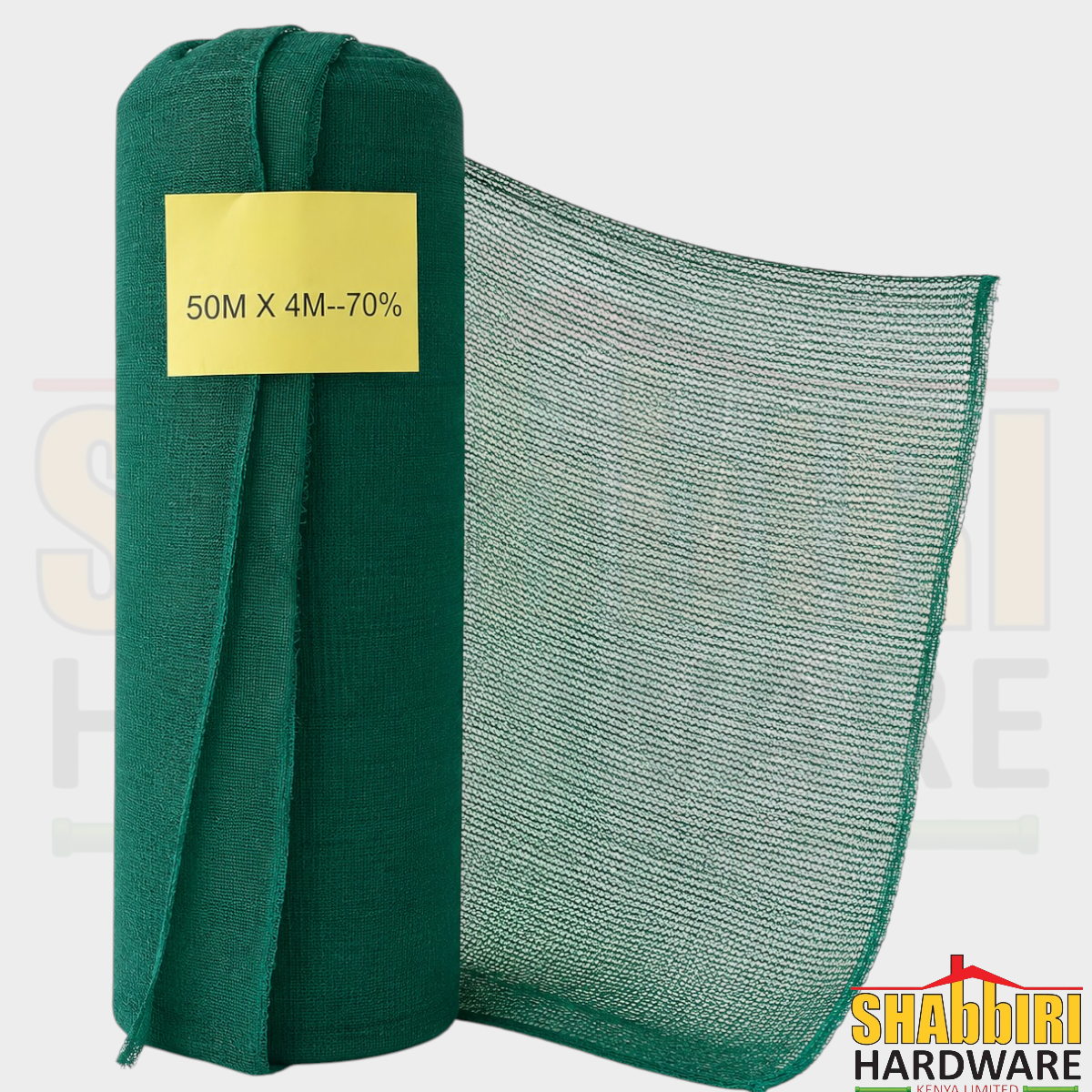
Black 90% in 25m x 3m, 50m x 3m and 50m x 4m; black 80%; and green 70%, 80% and 90% in matching sizes — including our popular Green Shade Net 70% 50m x 4m. We also cut to length by the metre.
Buy your shade net at Shabbiri Hardware — two branches in Ongata Rongai
Walk in, see and feel the net before you buy, and carry it away the same day. Both branches hold stock of the 90% black privacy screen in 25m x 3m rolls.
Shabbiri Hardware — Rongai Branch
Main branch & trade counterKajiado North, Nairobi Metropolitan, Kenya
Shabbiri Hardware — Tuala Branch
Past Nazarene UniversityMagadi Road, Kajiado North, Kenya
Get today's price on the 90% Black Shade Net
Tell us your boundary length or the area you want covered and we will tell you exactly how many rolls you need — and quote you in writing the same day.
Specifications
| Model | PSB-90% |
| Category | Shade Nets |
| Availability | In stock |
| Sourced by | Shabbiri Hardware Kenya Limited |
Customer reviews
No reviews yet — be the first to review this product.
Frequently bought together
Customers who bought this often add these to their order.