📍 Branch 1 — Ongata Rongai (Main)
Shabbiri Hardware — Magadi Road, Ongata Rongai
Magadi Road, Ongata Rongai, Kajiado North, Kenya
Heavy-duty knitted HDPE shade netting that blocks up to 90% of sunlight and sightlines — the standard choice for boundary privacy fencing, construction site hoarding, balcony screening, car shades, poultry houses, dog runs and windbreaks across Nairobi, Rongai, Tuala, Kiserian, Ngong and Kitengela. Sold by the metre or as full 50 m rolls in 2 m, 3 m and 4 m widths.
A 90% shade net is a warp-knitted high-density polyethylene (HDPE) mesh engineered to intercept roughly nine tenths of incoming sunlight while still letting air and rainwater pass through. Because the weave is so dense, it also blocks about 90% of visibility — which is why in Kenya it is sold interchangeably as 90% shade net, privacy screen fence net or simply green net fencing.
Raschel warp-knitted lock-stitch construction means the net will not unravel, fray or run when you cut it to size on site. Woven tape nets fray badly — knitted nets do not.
Virgin HDPE compounded with UV inhibitors so the net survives the intense equatorial sun at Nairobi’s 1,600–1,800 m altitude without going brittle in a single season.
Around 10% open area lets wind bleed through instead of loading the fence, and lets rain and irrigation pass straight to the ground below.
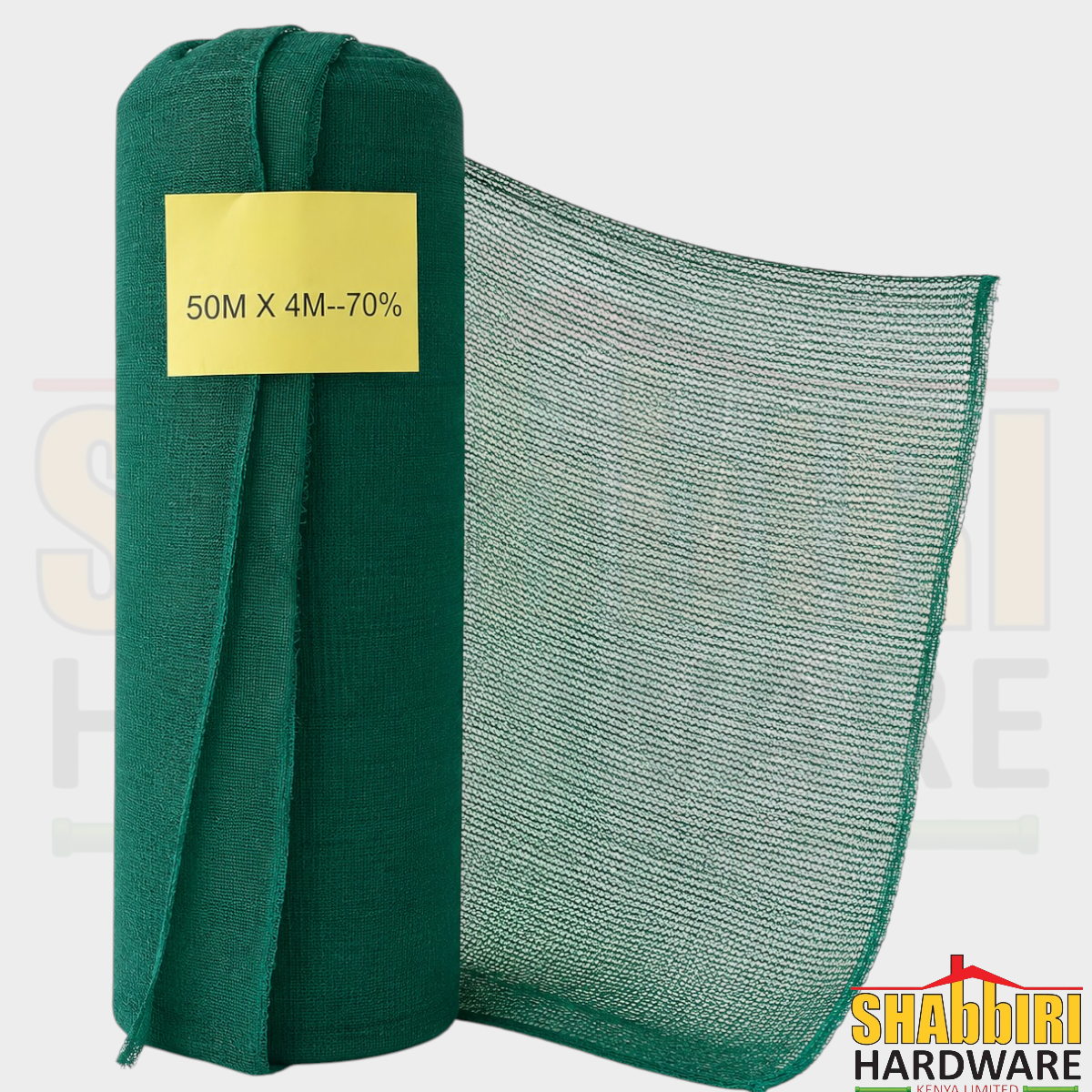
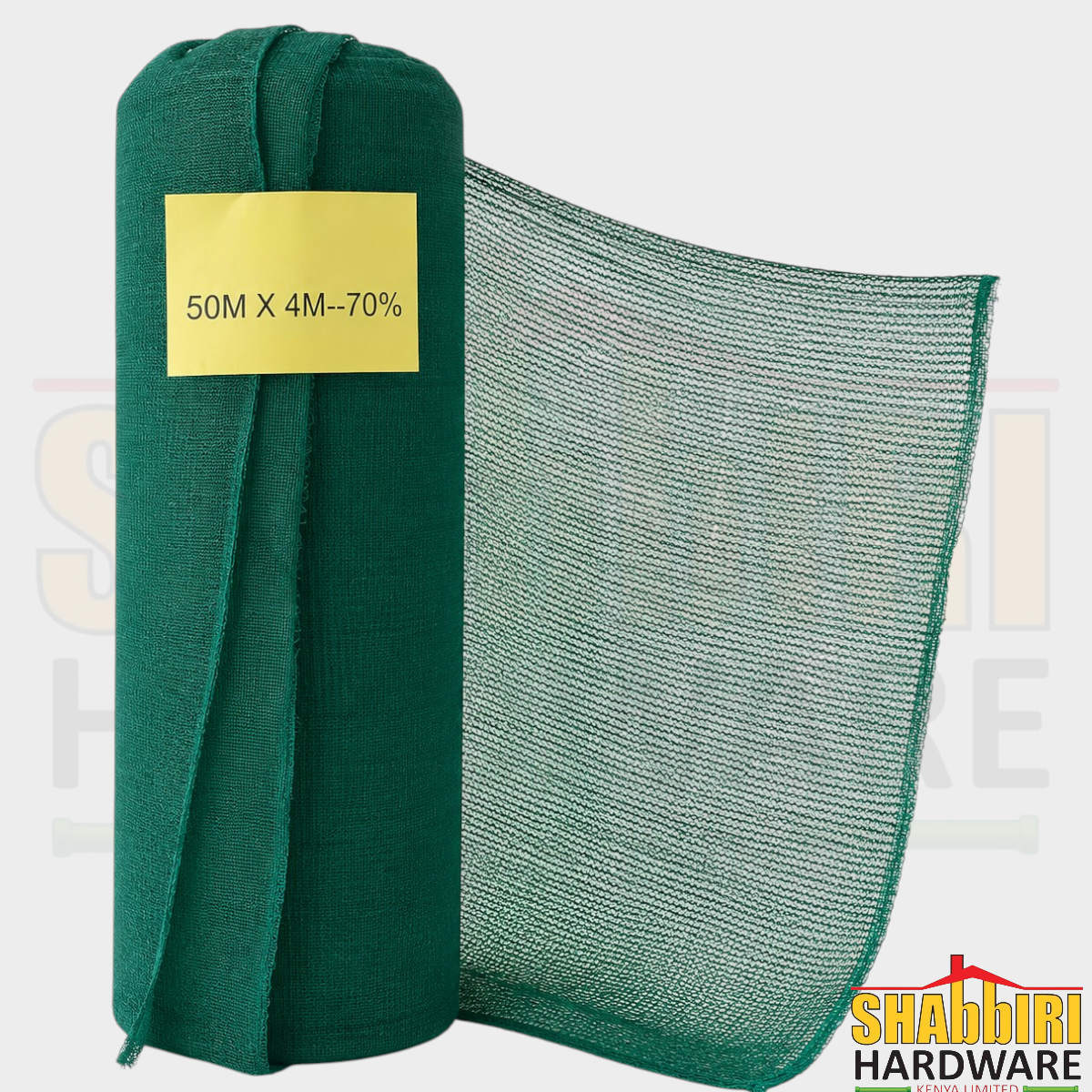
At 90% density the net reads as a solid green wall from a few metres away — ideal for boundary walls, site hoarding, balconies and swimming pool surrounds.
Buy a full 50 m roll or ask for a cut length by the running metre. We cut at the counter at both the Rongai and Tuala branches.
A 4 m × 50 m roll covers 200 m² — a fraction of the cost of masonry walling, chain link with slats, or timber screening, and it is re-usable.
Typical values for the 90% green privacy-screen grade stocked at Shabbiri Hardware. Exact GSM and roll dimensions vary slightly between production batches — confirm the batch spec at the counter or ask us to send the mill data sheet with your quotation.
| Specification | Value / Description |
|---|---|
| Product name | Shade Net 90% Green (Privacy Screen Net) |
| Shade factor | 90% ± 3% light interception |
| Privacy / visibility blockage | Approx. 90% — near-opaque at normal viewing distance |
| Raw material | Virgin high-density polyethylene (HDPE), UV-stabilised masterbatch |
| Construction | Warp-knitted (Raschel) lock-stitch mesh — non-fraying, non-ravelling when cut |
| Yarn type | Monofilament + flat tape combination |
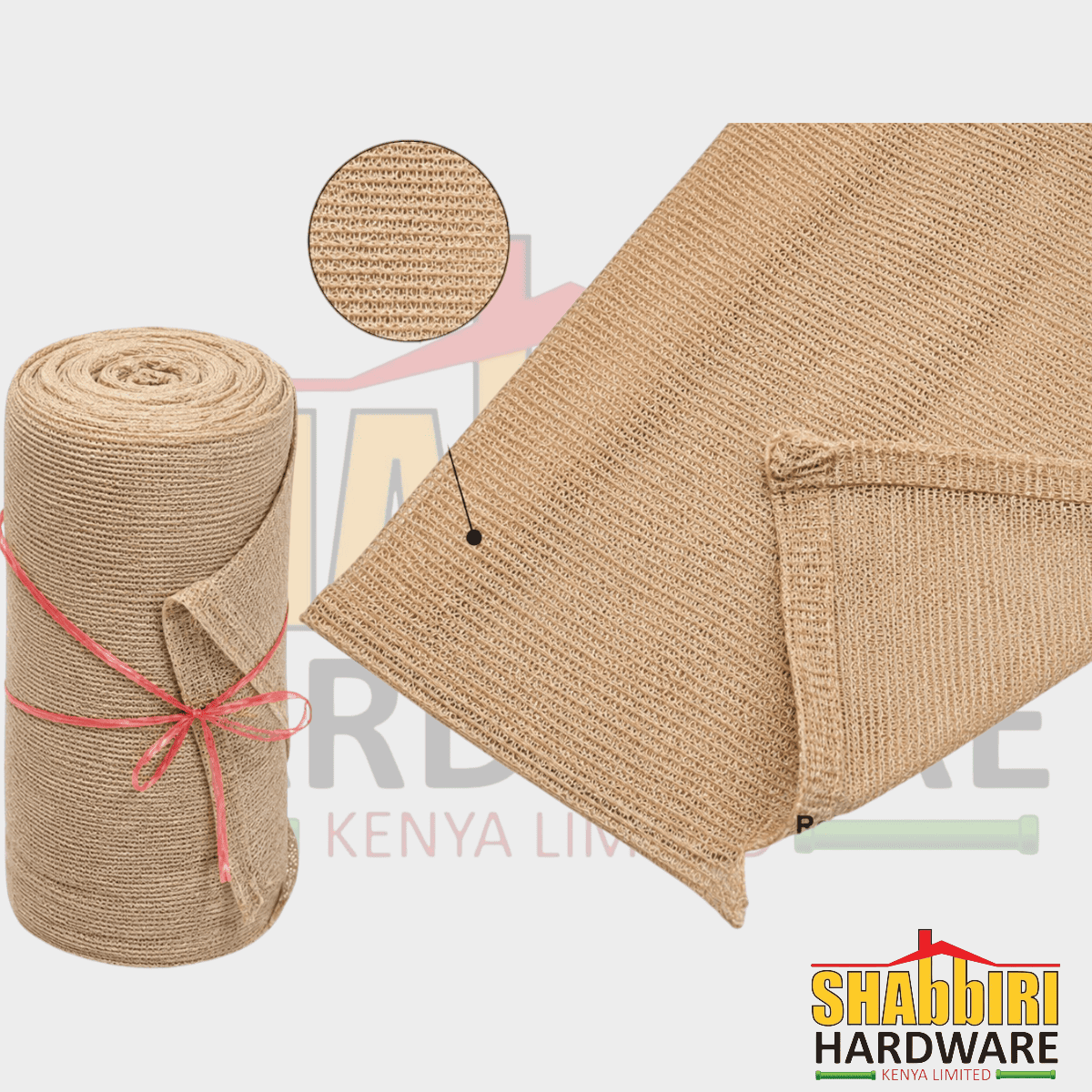
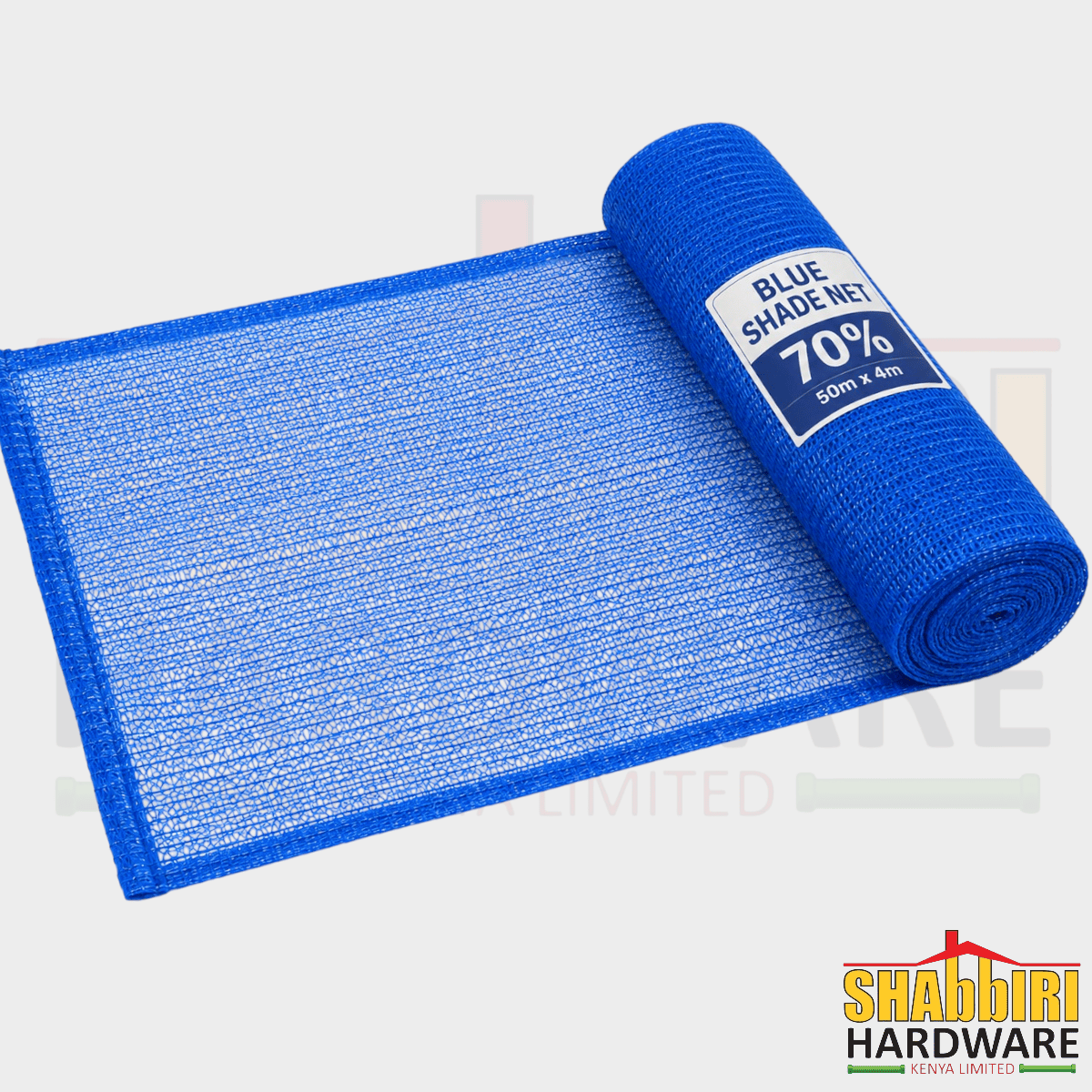
| Colour | Green (dark/leaf green). Black, beige and blue available on order |
| Fabric weight (GSM) | Typically 120–160 g/m²; standard stock grade approx. 140 g/m² |
| Open area / porosity | Approx. 10% — permeable to air, rain and irrigation water |
| Edge finish | Reinforced knitted selvedge on both long edges; eyelets/grommets at 500 mm centres available on request |
| Surface finish | Matt, non-reflective; identical appearance on both faces |
| Roll Format | Width | Length | Coverage | Typical Use |
|---|---|---|---|---|
| Narrow roll | 2.0 m | 50 m | 100 m² | Balcony rails, low boundary fences, dog runs, kennels |
| Standard roll | 3.0 m | 50 m | 150 m² | Perimeter privacy fencing, tennis/pool screens |
| Wide roll | 4.0 m | 50 m | 200 m² | Construction hoarding, car shades, poultry & nursery covers |
| Cut lengths | 2.0 / 3.0 / 4.0 m | By the running metre | — | Small repairs, gates, single-panel screening |
| Packing | Rolled on a core and bagged in polythene sleeve; roll weight approx. 14–30 kg depending on width | |||
| Property | Indicative Value |
|---|---|
| UV resistance | UV-stabilised for tropical/equatorial exposure |
| Expected service life | 3–5 years in full Kenyan sun when correctly tensioned; longer under partial shade |
| Operating temperature | Approx. −20 °C to +80 °C |
| Wind behaviour | Porous mesh bleeds wind pressure; acts as a 90% windbreak/dust screen. Fix to a rigid frame in exposed sites |
| Water behaviour | Rain and irrigation pass through; net does not pond or hold water |
| Temperature reduction beneath net | Commonly 4–8 °C cooler than unshaded ground in direct sun |
| Chemical resistance | Resistant to most agricultural fertilisers, dilute acids and alkalis; avoid prolonged contact with strong solvents |
| Fire performance | Not fire-retardant as standard. FR grades are available on special order — specify at enquiry stage if required by your site safety plan |
| Recyclability | HDPE (resin code 2) — recyclable at end of life |
| Warranty | Manufacturer’s UV degradation warranty where supplied by the mill; ask for the batch certificate with bulk orders |
The same roll solves privacy, dust, wind and sun problems on residential plots, construction sites, farms and institutions.
Fixed to chain link, weld mesh or timber posts to screen a plot from the road or the neighbouring compound.
Scaffold wrapping and perimeter hoarding that contains dust and debris while keeping the site out of public view.
Cable-tied to apartment balcony railings for privacy from facing blocks, plus glare and dust reduction.
Stretched over a steel or timber frame to keep vehicle interiors and paintwork out of direct sun.
Side curtains for chicken houses, calf pens and rabbit hutches — shade and wind protection with full ventilation.
Deep-shade tunnels for shade-loving ornamentals, mushroom sheds, cuttings and germination beds.
Windbreak and privacy screening around swimming pools, courts and school playfields.
Along exposed boundaries, quarry edges, murram roads and rooftop gardens to cut wind speed and airborne dust.
Reduces visual triggers for barking dogs while keeping kennels cool and ventilated.
Backdrops, VIP screening, generator and refuse-area concealment at outdoor events.
Schools, churches, clinics and gated communities where a quick, low-cost privacy wall is needed.
Protects stored timber, cement blocks, plant and equipment from sun bleaching and prying eyes.
A step-by-step method for fixing privacy screen net to a fence line. The same principles apply to car shades, poultry curtains and balcony screens — the golden rules are support the edges, tension evenly, and never rely on the mesh itself to carry load.
Measure the total fence length and the required height. Add 5–10% for overlaps at joins and for wrapping the ends around terminal posts. For a 30 m boundary at 2 m high, order 33 m of the 2 m wide roll.
Set straining posts at both ends, at every corner and at 25–30 m intervals along the run, with struts on the pull side. Intermediate posts every 2.5–3 m. Concrete the posts and let them cure before tensioning — the frame, not the net, resists the wind load.
Fit a straining wire along the top and the bottom of the run, and a third at mid-height for panels over 2 m tall. Tension with a wire strainer or turnbuckles until the wire is firm but not singing.
Unroll the net on the ground beside the fence, keeping the selvedge (finished) edges top and bottom. Cut with a sharp knife against a straight edge. A knitted net will not fray, but a hot-knife or a quick pass of a lighter flame along the cut edge gives the neatest finish.
Lift the net into place and attach the top selvedge to the top straining wire with cable ties or clips at 200–300 mm centres. Work from one end to the other, keeping the edge straight. Never space fixings wider than 300 mm — wide spacing is the single most common cause of tear-outs.
Pull the net horizontally hand-tight (about 2–3% stretch) before fixing the far end, then fix the bottom edge to the lower wire. Aim for a flat, drum-tight panel with no flapping pockets — flapping is what destroys shade net in the wind.
Wrap the ends around terminal posts and tie back on themselves. Where two rolls meet, overlap by 100–150 mm and stitch or cable-tie through both layers at 150 mm centres. Do not butt-join.
At corners, gate posts and any point where the net changes direction, add a doubled-over hem, an eyelet or a webbing patch before fixing. These are the points that fail first.
Trim excess, cut off cable-tie tails, and walk the line looking for slack panels. Re-tension anything that moves more than about 25 mm under hand pressure.
| Substrate | Recommended fixing method |
|---|---|
| Chain link / weld mesh fence | Cable ties or binding wire directly through the mesh at 250 mm centres, top, middle and bottom |
| Steel or timber posts only | Top and bottom straining wires between posts, then tie the net to the wires |
| Masonry or concrete wall | Expansion anchors + eye bolts, straining wire between them, net tied to the wire (never fix straight into the wall through the mesh) |
| Balcony railing | Cable ties around the balustrade at 200 mm centres; leave the bottom hem free to drain |
| Scaffolding | Purpose-made scaffold net ties or bungee ties on every standard and ledger; check ties weekly |
| Car shade / pergola frame | Hem all four edges with eyelets, then lace to the frame with rope or bungee for even tension and easy retensioning |
Compared with masonry walls, corrugated iron hoarding or timber screening, 90% shade net delivers privacy at a fraction of the cost and can be moved to the next job.
Work out running metres from your fence length, then pick the roll width that matches your screen height. Always add 5–10% for overlaps, wrap-arounds and offcuts.
| Job | Screen height | Roll width to order | Quantity rule |
|---|---|---|---|
| Plot boundary privacy fence | 1.8–2.0 m | 2 m | Fence length × 1.10 |
| Perimeter fence, taller screen | 2.5–3.0 m | 3 m | Fence length × 1.10 |
| Construction hoarding / scaffold wrap | 3.0–4.0 m | 4 m | Perimeter × 1.15 (allow for gates and returns) |
| Balcony screen | 1.0–1.2 m | 2 m (cut lengthwise) | Railing length × 1.05 |
| Car shade (single vehicle) | — | 4 m | Approx. 4 m × 6 m per bay + 300 mm hem all round |
| Poultry house side curtains | 1.5–2.0 m | 2 m | Total open wall length × 1.10 |
| Nursery / seedling shade tunnel | — | 4 m | Bed area (m²) × 1.20 for drop sides |
The questions customers ask most often at our Rongai and Tuala counters.
Shade net is priced per running metre or per full roll, and the rate moves with roll width, GSM and import costs. Because pricing changes, we quote current rates on request — call 0741 042484 or 0745 554008, WhatsApp us, or email info@shabbirihardware.co.ke with your length, height and quantity for a same-day quotation. Bulk and contractor rates are available.
It blocks roughly 90% of sightlines, so from about two metres away it reads as a solid green panel. Very close up, or with a strong light source directly behind it at night, faint silhouettes can still be made out. For absolute opacity, double-layer the net or specify a 95–98% privacy screen grade.
A UV-stabilised HDPE net that is correctly tensioned typically gives 3–5 years of full outdoor service. Life is shortened mainly by flapping, by fixings spaced too far apart, and by abrasion against sharp post tops — not by the sun alone.
No. It is warp-knitted with a lock stitch, so cut edges hold. For the neatest finish use a hot knife, or run a lighter flame quickly along the cut edge to seal it.
Only for deep-shade crops such as mushrooms, ferns and certain ornamentals, or as a side wall. For most vegetables and nursery stock, 90% is far too dark — use 30–55% for hardening off and general horticulture, or 70% for car shades and poultry. Ask us for the 70% green shade net instead.
Standard stock is 50 m rolls in 2 m, 3 m and 4 m widths, covering 100 m², 150 m² and 200 m² respectively. We also cut to any length by the running metre at both branches. Wider 6 m and 8 m rolls can be ordered in.
Cable-tie or wire it directly through the chain link at 250 mm centres along the top, middle and bottom, keeping the panel drum-tight. Run a straining wire along the top and bottom first if the chain link itself is slack.
The standard grade is not flame-retardant. If your site safety plan or an insurer requires an FR net — common on scaffold wrapping for occupied buildings — tell us at enquiry stage and we will source a certified FR grade.
Yes. A porous 90% net makes an excellent windbreak because it bleeds pressure through the mesh instead of creating the damaging turbulence a solid wall produces. It gives useful shelter for roughly ten times its height downwind.
Yes. We deliver from our Magadi Road (Ongata Rongai) and Tuala branches to Rongai, Tuala, Kiserian, Ngong, Karen, Langata, Kitengela, Athi River and the wider Nairobi area, and we arrange courier despatch upcountry. Call 0741 042484 to confirm delivery terms.
Green blends into landscaping and is the usual choice for residential boundaries and gardens. Black absorbs slightly more heat and is often preferred for construction hoarding, nurseries and where a neutral look is wanted. Both perform identically as screens.
Yes — cable ties, binding wire, straining wire, turnbuckles, eyelets, fence posts, chain link and the tools to fit them are all stocked at both branches, so you can complete the whole job in one stop.
Two branches serving Ongata Rongai, Tuala, Kiserian, Ngong, Karen, Langata, Kitengela and the wider Nairobi metropolitan area. Walk in, call, or send your measurements on WhatsApp and we will cut the net ready for collection.
Shabbiri Hardware — Magadi Road, Ongata Rongai
Magadi Road, Ongata Rongai, Kajiado North, Kenya
Shabbiri Hardware — Tuala
Magadi Road, Tuala — past Africa Nazarene University, Kajiado North, Kenya
Full 50 m rolls or cut lengths, plus every fixing you need to install it — straining wire, cable ties, eyelets, posts and chain link — all under one roof at Shabbiri Hardware, Magadi Road Ongata Rongai and Tuala.
| Model | PSG-90% |
| Category | Shade Nets |
| Availability | In stock |
| Sourced by | Shabbiri Hardware Kenya Limited |
No reviews yet — be the first to review this product.
Customers who bought this often add these to their order.